বুধবার, ২২ ফেব্রুয়ারি, ২০২৩

THE HUNGRY LUMINARY == MALAY ROYCHOUDHURY


THE HUNGRY LUMINARY— MALAY ROY CHOUDHURY (EPISODE 1)

TRANSLATED FROM THE BENGALI BY SRAMAN SIRCAR


1

By the time I noticed my sandal was torn, we had barely set foot outside the College Street Coffee House after wrapping up one of our usual intellectual chats that always began at 8 on Saturday evenings. The loop that held my hallux had come off, and while holding it between my middle toes, I had somehow scraped my way onto the street and was wondering if I should simply carry the sandal in my hands after all, since repairing it meant I would then have to walk all the way to Sealdah. I was with Subimal Basak. He immediately quipped that the realists among us would have argued it would have been wiser to leave the torn sandal behind at the Coffee House itself for those lacking such a possession.

Suddenly, a group of six to seven men leaped out of the darkness of the street and surrounded us. I recognized some of the faces in the dim light—they had left the café an hour earlier—and instinctively realized that we could save ourselves only by fighting them together. One of the men ran up to Ismail’s cigarette store beneath the staircase of the Coffee House, picked up the iron rod that had been resting there, and struck at us. Subimal blocked the blow, grabbed the rod with both his hands, and yanked with all his might—the man clad in dhoti and a shirt flew off his feet and smashed into the shuttered bookshop on the pavement. A dog groaned at the commotion in its sleep.

Now armed with the iron rod, Subimal let out a full-throated roar that shattered the silence of the night—Come out, you swines of Suresh Samajpati!—and landed a sickening blow on one of the attackers. Even in the shadows, I could see the sinews on his muscles had flared up like snakes raising their heads to strike. The men decided they had seen enough and all of them fled along Bankim Chatterjee Street and College Street. It was all over within a minute or so. With the rod on our shoulders and both my sandals hanging from it, we marched our way back home.

If Subimal Basak hadn’t been there with me that night, I would have been brutally thrashed for sure. In any case, I wasn’t well-versed in the Japanese techniques of martial arts. Subimal, however, had an appearance that was thoroughly unlike any poet—he was dark and burly with equally black curly hair and lacked all signs of nobility and sophistication. Originally from East Bengal, he would come across as an archetypical tough and obstinate proletariat. Back then he used to work at the Income Tax House in Chowringhee and resided in his paternal uncle’s tiny jewelry store in the Baithakkhana Bazaar near Sealdah. The year was 1963. I had visited Kolkata for about a fortnight and put up in his den.

The jewelry store used to bear a spartan look, was entirely windowless, and lacked even a ceiling fan; the two of us had to sleep on mattresses strewn on the floor. Answering nature’s call every morning meant going all the way to Sealdah station to make use of the trains idling along the platforms. Breakfast consisted of puffed rice and tea in cheap, earthen cups. For baths, we only needed towels and water taps on the adjacent street. The taps were often set so low that we had to crawl on all fours before we could sit under them. After drying ourselves, we would set off from Sealdah and travel through Bowbazaar till we reached Subimal’s office. While he would report to his department, I would venture to the roof of the Income Tax House and take a seat, with my towel serving as a cushion. Falguni Roy, a resident of Baranagar, and Tridib Mitra, who worked in the Writers’ Building at the time, would join us later in the afternoon for poetry sessions under the open sky, along with weed rolled into cheap cigarettes. When we felt hungry, Subimal would take us to his office canteen for lunch.

The nights were spent being a witness to Subimal’s literary experiments with the Bengali prosaic text called Chhaata Maatha. Lying on the mattress with a pillow under his stomach, he would spend hours deconstructing the narrative of the book, only to recompose it in the typical Dhakaiya Kutti style that had been characteristic of the old Bengali dialect once popular in East Bengal. I could never offer any help in this regard since the dialect was not known to me. As Subimal scribbled new words and phrases from his diary onto a piece of paper, the dim light of the lone lamp would cast a shadow of his head on the wall, its oily smell soon wafting all over the store. The idle yawns of old men would occasionally float in from the street outside. Every now and then, Subimal would blurt out, “Hey Malay, there’s someone in my ears again, I can clearly hear them speak!” and then wait for this supposed angel in his ears to offer him a novel word or an interesting turn of phrase, almost jumping in excitement whenever the angel would so oblige. His literary struggles would last late into the night, while I would fall asleep with an arm over my eyes and a dull pain in my calves from all the miles walked in the day.

We had been attacked with an iron rod the other night in retaliation for the masks we had gifted earlier. Subimal Basak, Debi Roy, and I had once chanced upon an enormous stockpile of masks being sold really cheap at wholesale rates in the Bagri Market of Burra Bazaar. We immediately bought two hundred of them—masks that depicted everything from animals, birds, and vermin to jesters, idiots, and monks. We even got a local job press to stamp the following message on them— 

Kindly Take Off Your Masks

Hungry Generation

Over the next few days, we began sending them off by post. Several were also directly placed in the letterboxes of the homes of prominent individuals. We spared no one: poets, authors, politicians, bureaucrats, police officers, professors, journalists, and businessmen were all at the receiving end. Soon afterward, gales of fury and indignation began raging throughout the city. Such a reaction was expected, but the brutal attack was not. The litterateurs of the day who had sent the goons after us are now lost in time, I don’t even come across their names or works anymore. It seems they have been utterly crushed under the weight of the literary establishment and turned into excellent manure for the fields! Back then, however, they were outraged by our masks and had deemed such an act totally unbecoming of poets and writers.

Before the advent of the Hungry Movement within Bengali literature, authors and poets here would go around looking unperturbed and unkempt, proudly flaunting their indifference to all worldly matters. Dressed mainly in a khadi kurta-pajama with a bag on their shoulder, they would judge the world through their languid, half-closed eyes like the typical frail matinee hero of the cinema of yesteryear. Interested only in the elitist Bengali favored in bourgeois circles, they relished ranting about how good they were and how bad was the rest of the world. They were so blindly obsessed with the vocabulary popularised by Rabindranath Tagore that, more often than not, their work read little better than literary fodder for the high-income groups. And when it came to portraying the lives of the lower classes in society, except the writers of the Kallol Movement, everyone else was busy putting vapid, petty bourgeois idealism on paper.

Despite the literary uproar brought in the wake of the Bengal Renaissance of the 19th century, by the beginning of the 1960s, the social duty of authors was entirely limited to merely influencing the tropes and motifs prevalent in the literature of the time, rather than using language to create a better society for posterity. As a result, there was a glaring absence of literary works that could radically alter the very intellectual framework of Bengali society. Literature was deemed to be primarily a so-called fine art that was excessively reliant on Tagore’s vocabulary, and elitist Bengali litterateurs entirely lacked the courage to incorporate the syntax and diction of the marginalized groups into their work. Subimal Basak and Subhash Ghosh, two of the poets actively involved with the Hungry Movement, were actually the first to do so within their own writings. Like the authors of the Kallol Movement, they were able to expand the horizon of literature by focusing on the experiences of the marginalized and interpreting them within the right social context. However, unlike the Kallol writers, the authors of the Hungry Movement themselves came from the lower classes, and naturally, their work evolved into a subaltern shockwave within the Bengali literature of the era. 

2

The Hungry Movement had originally been my brainchild. After the final exam of my MA in Economics at Patna University, there was ample time on my hands. The various threads of Marxist ideology were all tangled up in my mind back then, and I would relish sorting them out, only to entwine them once again. Meanwhile, my diary would keep getting heavier with more and more poems. I would also travel a lot with my friend Tarun Sur; sometimes we would go to Allahabad or take a steamer to Shonpur, a truck to Kolkata, or a bus to Ranchi. My elder brother worked for the Fisheries Department in Chaibasa at the time, and his friends from Kolkata—some of whom were well-known poets of the 1950s—often visited him to enjoy the region’s country liquor. Chaibasa was steeped in the sights and sounds of traditional tribal society, and I would go there too every now and then. Roaming all alone in the forests of the place, I would often explore the different villages of the Santhal tribe, observing the customary bloody cockfights where the birds would have knives tied around their feet. Upon returning to Patna, I would always be scolded by my father for my aimless wanderings.

Mother would fret over me as well since my paternal grandfather had a similarly restless disposition, and he refused to settle down anywhere despite roaming almost the entirety of South Asia all the way from Rangoon to Rawalpindi. He worked as a professional painter during the colonial era creating watercolor portraits of royal women from the various feudal kingdoms of the subcontinent. My father picked up some of his skills and later opened a photography studio in Patna. At the same time, my uncle was also hired as an artist by the Patna Museum. That’s why after the demise of my grandfather, our family put down roots in the city of Patna itself. My paternal grandmother Apurbomoyi, on the other hand, used to reside in our ancestral home in Uttarpara. A highly orthodox Brahmin lady, she would roam all over the home muttering to herself with just a red towel around her otherwise bare body. She spoke Bengali with a thick, colloquial accent, pronouncing words like ‘Brahmin’, ‘Kayastha’, or ‘motorman’ as ‘Bemmo’, ‘Kayet’, or ‘mochorman’ respectively. I was always afraid that she would raise a furor over my habit of eating beef and pork despite being a Hindu, and that’s the reason why I preferred putting up with Subimal in his uncle’s jewelry store in Kolkata.

Then came the year 1961. After the results of the MA final exam were out, my father began coaxing me to apply for higher studies at the Delhi School of Economics. But by then, I had already become captivated by the world of poems. Only twenty-two years old at the time, I was totally obsessed with poetry and Marxism. One day, I suddenly came across an interesting expression by the English poet Geoffrey Chaucer that completely turned my world upside down: In the sowre hungry tyme. Hungry time, and that too a sour, hungry time! It made me realize that even in Bengali, the verb ‘eat’ has been subtly used to convey a plethora of meanings—we eat a kiss, as opposed to giving one; we eat a beating, rather than receiving one; if you’re corrupt, you might eat a bribe; you could eat your head off when annoyed, or eat the wind while going for a stroll. The word ‘hungry’ by then had a firm grip on my mind, and I decided to appropriate Chaucer’s hungry time for our own Indian literary traditions.

The elitist poems of Buddhadeb Basu, Amiya Chakrabarty, Bishnu Dey, and Sudhindranath Dutta were all the rage back then. The leftist journals were dominated by Subhash Mukhopadhyay, Dinesh Das, and Birendra Chattopadhyay, while the little magazines were obsessed with Shankha Ghosh, Alokeranjan Dasgupta, Alok Sarkar, and Sunil Gangopadhyay. The intellectual essence of their poems was based entirely on the world of privileged society. Their language was the mollycoddled tongue of the upper classes, with 90% of their vocabulary borrowed from Rabindranath, and they were particularly proud of their ability to dig up the most arcane and complicated words from the dictionary. The upcoming poets of that era were meanwhile mesmerized by their literary hero Buddhadeb Basu, who was known for being the Casanova editor of the Kabita magazine and could often be seen in a nightgown drinking tea with sugar cubes. Teeming with hatred, malice, fury, envy, inebriety, debauchery, and cynicism, their poems amounted to little more than philosophical sacrilege. They also used a host of bookish prosodies just to keep the reader distracted. Being mired in the petty-bourgeois environment, they could not even dream of challenging the reader through their poetic rhythm. Even their translations did not do justice to the work of foreign poets, since they were often marked by their own voice and style in Bengali. And when it came to the eventual poetic quality of their work, it always turned out to be utterly timid and effeminate.  


The above has been excerpted from the book titled Hungry Kingbadanti: History of a Literary Revolution written by Malay Roy Choudhury, and first published in July 1994. This is the first in the series of writings from the book that will be published eventually on the magazine’s website. Keep a lookout for the upcoming episodes!


.


বৃহস্পতিবার, ১৯ জানুয়ারি, ২০২৩

Hungryalist Movement : Sreemanti Sengupta


Hungryalist Movement : Pure or Profane? Roddur Roy’s Arrest Can Be a Defining Moment for Bengal’s Social Grammar

By Sreemanti Sengupta in Wire, 15th June 2022

In jail for nearly a week over 'derogatory remarks' against CM Mamata Banerjee, the vlogger is famous for his freewheeling expression. He has a few noted predecessors.

Pure or Profane? Roddur Roy’s Arrest Can Be a Defining Moment for Bengal’s Social Grammar

Kolkata: “They are not understanding art! I am not a terrorist, I am an artiste!,” Roddur Roy shouted as the government vehicle carrying him left the Bankshall court premises on Tuesday, June 14.

YouTuber Roddur Roy was charged under 12 sections of the Indian Penal Code, including ‘promoting enmity’ and ‘provoking riots,’ in a case registered at Kolkata’s Hare Street police station for allegedly making derogatory remarks against Chief Minister Mamata Banerjee.

But Roy had a surprise waiting for him when he was produced before the court on Tuesday after six days in police custody. He learned that a fresh case against him had been taken up for hearing by another court at the same complex. 

The latest case is in connection with a complaint that had been lodged against him by a private tutor at Burtolla police station in June 2020 on the basis of remarks he made during a Facebook live broadcast in May 2020. In it, Roy had allegedly insulted the Indian Army and Union home minister Amit Shah. While the court hearing the case lodged at Hare Street police station sent him to judicial custody, the court hearing the Burtolla police station case sent him to police custody till June 20. 

The arrest has triggered intense debates among Bengalis on social media, with human rights organisations like the Association for Protection of Democratic Rights (APDR) condemning it and demanding Roy’s unconditional release, while there are others who have expressed wishes to see him rot in jail. 

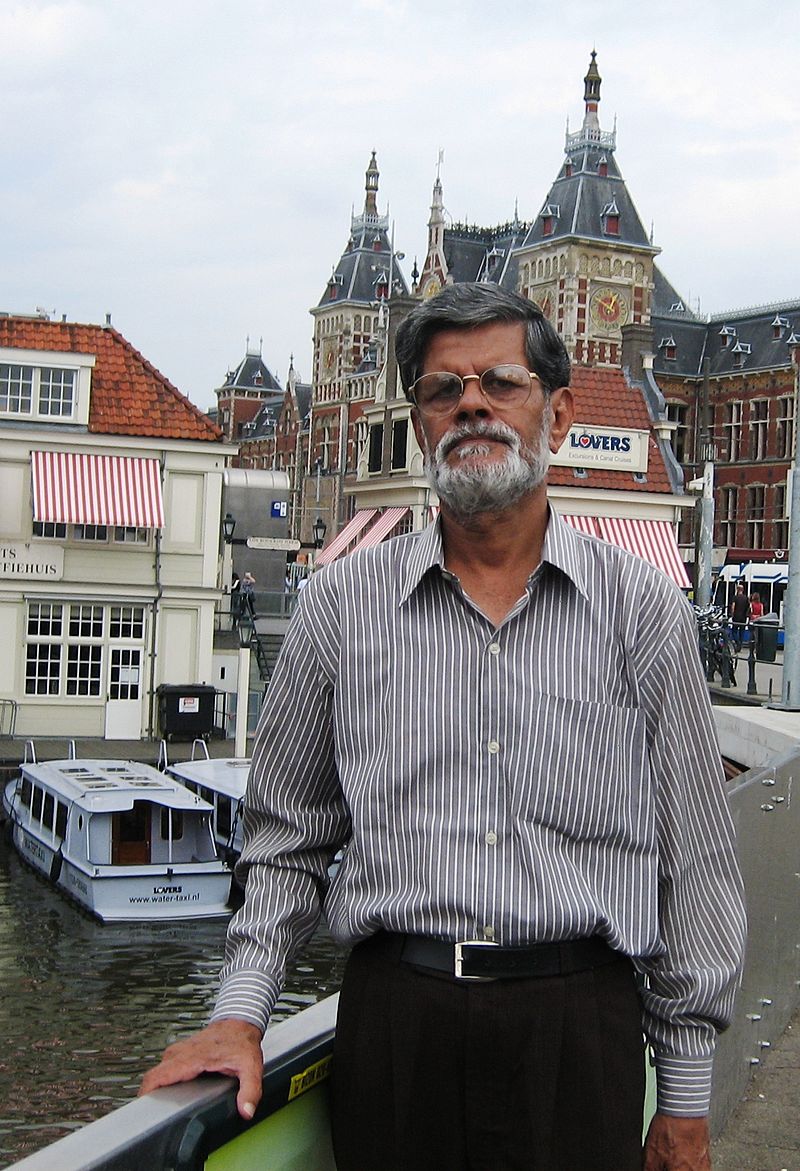
Malay Roychoudhury. Photo: Wikipedia (CC BY-SA 3.0)

Malay Roy Choudhury, who was a key member of the Hungry Generation literary movement and faced an “obscenity trial” for his infamous poem Stark Electric Jesus, knows a little about this experience. He was jailed for a month in 1964.

“I think that after he is released (from jail), Roddur Roy should stand up on a table in the Coffee House and proudly speak the language of the uncivilised. It is not enough to hurt the (conservative) sentiments of West Bengal. All those who have ruined Indian politics must also be seriously hurt…I have no regrets about the obscenity trial I faced. That is why I can live proudly even as an octogenarian. I wrote what I felt like then, and write that way even now. My writings are my weapons,” Roy Choudhury says.

The Indian Coffee House in College Street is famous as one of Kolkata’s most popular cultural hubs and was once known to attract luminaries.

Roy is a smooth-talking, marijuana-smoking, guitar-strumming vlogger with 3.28 lakh subscribers on YouTube and 4.91 lakh followers on Facebook. His image is that of a dystopian prophet – he has founded his own religion, Moxa, and his growing fan base is fond of his expletive-ridden rants and off-key singing. They call it “true freedom of speech” and thank him for being “the child to point out to the emperor that he is wearing no clothes”.

Hours before Roddur Roy was arrested from his Goa residence on June 7 for allegedly using indecent remarks to describe Banerjee, and her nephew Abhishek Banerjee, a Lok Sabha MP of the Trinamool Congress, he took to YouTube to airily address the issue.

“This language is not meant to insult you. This is completely apolitical – I am not part of your dirty politics,” he said, passionately defending his use of profanity.

“Obscenity is everywhere, it is part of humanity – there is nothing unnatural about it. Am I raising communal violence or threatening to kill someone? Then understand my motive first! The motivation is the commoner’s right to peace. Can’t I speak for peace?…What is so offensive about my language? And who are you to correct my language? Is this a grammar class?…Is your language perfect? Is the perfect language spoken in this state? Do you know there are spelling errors in Government advertisements?”

The use of words deemed ‘obscene’ to express frustration against the socio-political scene is not new.

Bengal experienced a torrid affair with profanity when the Hungryalist movement burst into its horizon in the 1960s. As a true corollary to the Beats in America, this movement concentrated on creating a new idiom of countercultural expression meant to disturb oppressive social hegemony.

In 1964, Kolkata police conducted a spree of arrests, rounding up 11 Hungry writers, including Pradip Chaudhuri, Saileshwar Ghosh, Subhash Ghose, Samir Roy Chowdhury, Malay Roy Choudhury and Haradhon Dhara (alias Debi Roy).

Some writers of the Hungry generation. From top left, clockwise: Saileswar Ghose, Malay Roy Choudhury and Subhas Ghose Basudeb Dasgupta, David Garcia and Subimal Basak. Photo: Wikipedia (CC BY-SA 3.0)

Filmmaker Q – who has directed Gandu, a film perceived as obscene – and liberally uses profane expressions to attack the status quo, thinks that Roy has become the ‘art of profanity’ or the ‘character itself’, and has therefore lost the need to be the ‘civilised artist’ with social responsibilities. 

Referring to Bengal’s trysts with obscenity, Q said, “If I chart a line from Nabarun (Bhattacharya) to me and then to Roddur, then he becomes the character and loses the need to appear civil to be taken seriously. And that’s a huge progress, that he, in the times of social media, could fully embrace the character and become a Gopal Bhand or Birbal (court jesters famous in Indian literature) type of character who is a constant nuisance but who the king has to pay so that there is a continuous stream of consciousness from the other end.”

However, as expected, not all Bengali intellectuals are on board with Roddur’s generous use of cuss words.

Roddur Roy’s antics had pushed him into the limelight of controversy in 2019, when he punctuated a famous Tagore song with expletives. What riled up the Bengali bhadralok society the most was when students from Kolkata’s Rabindra Bharati University sang Roy’s version of the song during Basanta Utsav or the spring festival in March 2020. 

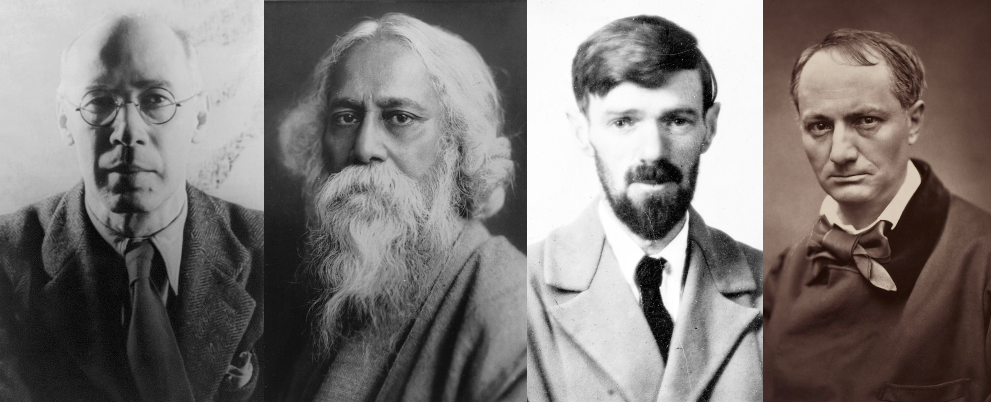
Speaking on Roddur Roy’s reckless use of swear words, Sanjay Mukhopadhyay, film and literary critic said, “Roddur Roy’s problem is that he is not philosophising his language. The poems that were banned from Charles Baudelaire’s Les Fleurs du mal had returned with full glory in the post-War period as treasures of French literature. Same with D.H. Lawrence’s Lady Chatterley’s Lover or Henry Miller’s Tropic of Capricorn – once banned and now regarded as literary gems. This is only because we have been able to place them in a larger philosophical context in the present day, and therefore they are successful subversions.”

DH Lawrence, Rabindranath Tagore, Henry Miller and Charles Baudelaire. Photos: Public domain.

However, he also presents the debate in an alternative light when he cites an example from Tagore who in a romantic song asks, ‘Why didn’t you wake me up before dawn? My day has passed in shame’. The song is heard in almost every Bengali household. However, the sidewalks of north Kolkata’s Chitpur area, full of volumes of erotic literature, have this song under the collection titled Beshya Geeti (songs of the prostitutes).

“Even eminent poet and playwright Dwijendralal Ray accused Tagore of penning obscene music. He wondered how Bengalis would protect their civility if these songs are sung in civilised society. The question today is, how do we determine what is obscene and what is not?” Mukhopadhyay said. 

Q thinks that to seek philosophy or higher meaning is a standard ‘upper’ class reaction.

“In the 1920s Kolkata, the common language that was used was fairly profane, which is today looked at as an extremely downgraded language. This happened due to the huge pressure from the Tagore family and other Brahmo Samaj members who wanted to clean up the language so they could appear civilised and belong to the genteel society. And what happened as a result is that we completely lost how coolly a different strata of the society could use language at that time,” said the filmmaker. 

Howard McCord, a renowned American academic, poet, and educationist, came to India on a Fulbright scholarship and worked in close proximity with the Hungry Generation writers while pursuing passionate studies of Indian literature of the 1960s. When approached on the subject of using profanity in literature, he said “While I swear in my private speech, I do not swear at work (in class or office, nor in my lectures). My writing is largely poetry, or responses to literature.”

As Bengal stands divided on his persona and his language, Roy himself seemed to shrug it off in the last video he uploaded just before police arrested him from his Goa residence, “You can corner me, you can put me in jail. But that will not make a positive history with your name.” 

Addressing Banerjee, he had added: “If the people have elected you as the chief minister, then it is your duty to let the ordinary man speak, pick whatever is positive out of it, and use it to make a change.”

Sreemanti Sengupta is a freelance writer, poet, and media studies lecturer based in Kolkata.


Hungryalist Movement : Snigdhendu Bhattacharya


Hungryalist Movement : How American Little Magazines Took Contemporary Indian Poetry To US In '60s And '70s

By Snigdhendu Bhattacharya , 7th June 2022

In contrast to pre-Independence writers looking to get their work published in the UK, postcolonial writers started preferring the US.

Over a decade before the Pritish Nandy-edited The Vikas Book of Modern Indian Love Poetry (1979) and the Keki Daruwala-edited Two Decades of Indian Poetry: 1960-1980 (1980) brought postcolonial poetry written in a range of Indian languages before the English readership, or the speakers of other Indian languages, a 74-page compilation titled Poetry of India was published in the US, giving contemporary writers in different Indian languages a readership beyond linguistic borders. Nandy was one of the poets included in the 1968 publication. Four years later, in 1972, another publication came up in the US, titled Young Indian Poets, a 96-page publication. 

In the early '70s, English translations of contemporary writings in Indian languages were still rare to find in India, and those available were mostly the writers’ own translations. The English language publishers in India were interested mostly in publishing Indian writers who wrote originally in English. Anthologies of Indian English writings had come up, at least three during 1972-73, but not anthologies of writings in Indian languages. 

Thanks to Beatnik poet Allen Ginsberg’s India tour during 1961-62, when he spent long hours with poets in Kolkata, Mumbai, Patna and Varanasi, translations of contemporary Bengali poetry, chiefly those of the Hungry Generation writers, appeared in the first three issues of the iconic City Lights Journal, published by Beatnik poet and publisher Lawrence Ferlinghetti. The interest this generated in the US literary circles about contemporary Bengali literature subsequently spread to other Indian languages, as becomes evident from Howard McCord’s 1965 visit to India under the Fullbright scholarship and enrollment at the Mysore University. 


Postcolonial literature in India, those in the 1950s and the 1960s, saw three interesting trends. First, a new kind of writings challenging the predecessors appeared in all major languages – Krittibas and Hungry Generation movements in Bengali, Navya in Kannada, Nabakatha in Marathi, Nayi Kavita and Nayi Kahani in Hindi, for example. Arvind Krishna Mehrotra wrote that they were all more or less same in nature and heavily influenced by European writings and Existentialism. 

“This was a consciously modernist movement, one that broke from the classic predilections of the past and redefined the concerns of literature,” Mehrotra wrote in A History of Indian Literature in English (2003), “From Hindi to Kannada, Tamil to Bengali, younger writers ‘killed their fathers’ with a vigorous new prose.” 

The second changing trend was that while writers during the colonial period were more keen on their translations of their works published from the UK, the postcolonial writers were keener on getting them published in the US. The third trend was the emergence of the little magazine movement in all these regional literature. 

Under these circumstances, Ginsberg’s trip played the bridge. In fact, it was Ginsberg’s letters from India to Ferlinghetti that prompted him to launch a new annual journal. In 1963, he wrote to Ginsberg in India, “I have just been prodded by your India descriptions to start another Journal and publish your description in it, along with anything else you send.”

After the first issue of City Lights Journal (1963) published parts of Ginsberg’s India journal, Gary Snyder’s prose A Journey from Rishikesh to Haridwar' and the manifesto of Bengal’s Hungry Generation Movement, the second issue of the journal published extensive translations of both Krittibas group of writers and the Hungrialists, under the heading ‘A Few Bengali Poets.’ The third volume (1966) also included writings from Bengal, as well as a piece by McCord on the Hungrialists. 

In fact, McCord in his piece said that it was the journal’s 1963 edition that generated interest in the US about new Indian writings, especially those in Bengali. By 1967, Salted Feathers had published a whole issue titled ‘Hungry!’ 

Coming back to the 1968 publication, Intrepid was a small press, part of the American ‘little magazines’. German writer-translator Carl Weisner, who was a close associate of the Beat generation writers, was the editor of that particular issue. More than half of the issue were translations of the works of Bengal’s Hungry Generation and the Krittibas group of writers, and the rest was titled as “Poets from Delhi, Bombay and Allahabad.” 

The second half included the works of Arvind Krishna Mehrotra, Kamla Das, Pavankumar Jain, Arun Kolatkar, Dilip Chitre, Ashok Chopra, Pritish Nandy, Rabindra Nath Gupta, Shyam Parmar and Satish Jamali. Some of these poems were originally written in English. The Bengali section included the works of Malay Roychoudhury, Subo Acharya, Pradip Choudhuri, Saileshwar Ghosh, Subhas Ghose, Debi Ray, Subimal Basak of the Hungry Generation and Sunil Gangopadhyay, Tarapada Roy, Shakti Chattopadhyay and Shankar Chattopadhyay of the Krittibas group.

It Included Mehrotra’s Bharatmata: A Prayer, Pavankumar Jain’s self-translated Gujarati poem The Moon, Dilip Chitre’s translation of Kolatkar’s untitled work, Ashok Chopra’s Birth of a Bed from ‘Town Poems’, Pritish Nandy’s Gemara and Herod & I, Chitre’s The First Five Breakfasts Towards Self-Realisation, Kamala Das’ Convicts and The Descendants, Rabindra Nath Gupta’s All Flesh, Shyam Parmar’s Snake Harvests and Satish Jamali’s ‘anti-poems’


Most of them translated their works themselves and some (mostly Bengalis) in collaboration with Weisner and American poet Michael Aldrich, also one who had been associated with the Beats. The collection, interestingly, offers in the appendix the corresponding addresses of all Indian writers, with Weisner commenting in his introduction that “Indian poets crave contacts with poets and editors in the States” and that “they would like to exchange their publications with magazines in America.” 

In fact, such collaboration between the Indian and American little magazines had already started taking place, with Mehtrora’s magazine, Ezra, publishing McCord’s poem in its third volume (1968). Subsequently, Mehrotra and McCord had exhaustive exchanges between them, which are now part of archival collections in the US. 

McCord’s proximity with the Hungry writers and with other regional writers through Mehrotra culminated in his 1972 publication, Young Poets of India, from his own The Tribal Press, in the third volume of the magazine Measure. This again, offered a broad view of contemporary Indian poetry, with most of the writers mentioned above finding their works included. 

By the time the David Cevet-edited, The Shell and the Rain: Poems from New India, was published from London by Allen & Unwin, it was 1973.


রবিবার, ৮ জানুয়ারি, ২০২৩

Hungryalist movement did continue after 1965

   The movement did continue after 1965      

 Malay Roychoudhury interviewed by Nishtha Pandey

Nishtha : In your own words, can you explain briefly why the movement ended? Were the reasons purely political?


Malay : People thought that the movement ended after I left Kolkata in 1967 consequent upon my exoneration at High Court and my getting a job in Agricultural Refinance & Development Corporation, Lucknow. I was from a Patna slum called Imlitala and did not have any knowledge of agriculture and rural life. I had to gain knowledge by reading about rural life. The movement was continued by other members but they did not give publicity to their magazine “Khudharto '' as I did by distributing leaflets and pamphlets which reached readers quickly ; nobody had to pay. Leaflets/pamphlets  had a greater reach as some of them were in English as well. “Khudarto” was in Bengali and Kolkata Centric. In fact seven issues of “Khudharto’ were published as an anthology by Sahitya Academy. Unfortunately those who published “Khudharto '' took a decision to have only a few writer friends as contributors. I used to increase the number of participants which included writers, poets, dramatists, cartoonists and painters. The movement took roots in North Bengal and Tripura in 1975-1980 but then again they were not publicized. Politics played a role as far as the then West Bengal government wanted to stifle our voice, arrested us and charged me for my poem Stark Electric Jesus. When my elder brother returned to Kolkata and started a literary magazine called HAOWA39, and I got transferred to Kolkata, interest among younger generation writers about our movement received attention. I was requested to write about the movement by a magazine of Bangladesh which was republished in Kolkata by a publisher and published again by another publisher with lots of photographs. After Maitreyee Bhattacharjee Choudhury wrote The Hungryalists published by Penguin Random House, the movement again got an Indian attention.


Nishtha : Performing poetry was a big part of the Hungry Movement, it aimed at raising people from their passive state. Is there a particular performance that is striking to you, or stands out more than the others?


Malay : There were a few of them. One was at the cemetery of Michael Madhusudan Dutt, limited to us only, though Tridib Mitra and his girlfriend Alo Mitra had distributed cards of the event among writers and poets. The one which attracted a crowd was at Howrah station when I stood upon a bench at platform number one and read the Bengali version of Stark Electric Jesus loudly. Tridib Mitra read his poem Hatyakand. Third was at country liquor den Khalasitola on Jibananda Das’s birthday when Abani Dhar got up on a table and sang a song ; he had worked as a ship mate for some time. This became news in the next day's newspapers and literary magazines. The incident has also been included in the book ‘A Poet Apart’ by Klinton B Seely, on Jibananda Das’s life and poetry.


Nishtha : The Hungry Movement was a combination of the literary and the political when at its peak. How did this come about? Did one aspect stem from the other or were both of them intertwined from the beginning?


Malay : Both of them were intertwined from the very beginning as Hungry Generation manifestos were issued not only on literature but also on politics and religion etc. The then daily ‘Jugantar’ wrote its main editorial on consecutive days about our political manifestos. Our poems, short stories and drama had political overtones. Politics came automatically as the movement itself was a reaction to the plight of refugees at the Sealdah railway station. 


Nishtha : Caste equality was an important fight that was led by the Hungryalists. Can it be the sole reason why the movement always garnered unwanted attention from the literary elite of Bengal, and eventually from the state?


Malay : I do not think so. Elitist literary magazines did not publish under-caste works. We wondered loudly as to why they were excluded from Buddhadeva Basu, Sushil Roy, Sunil Gangopadhyay’s poetry magazines. Haradhan Dhara had to change his name to Debi Roy, since Dhara means cultivator caste, so was Sambhu Rakshit. Sunil Gangopadhyay ridiculed Haradan Dhara in letters to his friends. Actually the then Establishment was dominated by upper castes. It is the elites who requested Kolkata Police to take action against our movement. 


Nishtha : Do you think the movement’s delicate position in a postcolonial country, in post-independent Bengal, affected the fate of the movement, particularly the end, compared to let’s say the Beats in America?


Malay : The Beats came from rich families. Very rich families, when you think of Ginsberg, Kerouac, Burroughs. We were paupers compared to them. Saileswar Ghosh, Subhash Ghosh, Basudev Dasgupta, Pradip Choudhuri came from refugee families. Haradhan Dhara had to work as an errand boy at a tea stall ; his mother collected garbage from vegetable markets. Falguni Ray did nothing.  came from a slum. We did not get publishers for our books for more than two decades.


Nishtha: Do you think the friendship with Allen Ginsberg propelled the Hungry Movement in any way? Did his visit act as a catalyst for the movement?


Malay : Yes it did. Not in India but in America. In India prominent Hindi, Gujarati and Marathi writers wrote about our movement in the papers/magazines of their languages. Allen Ginsberg sent our manifestos and bulletins to Lawrence Ferlinghetti who published them in four issues of his City Lights Journal. This attracted other editors and writers of various little magazines in the USA, Latin America, Europe, Turkey and Arab world.  Research is being done in those activities by academicians now. You may find them in academia.edu. But his visit can not be termed as a catalyst. Our movement started in November 1961 and Ginsberg came in 1962. He met my elder brother Samir in 1962 and came to meet me at Patna in April 1962. My photographer father was annoyed with Ginsberg when he found out that Ginsberg was taking photos of lepers, beggars, destitutes, half-naked sadhus. He eventually made money by printing them in India Journals and Exhibiting them in various studios. He was, like other foreigners, an Orientalist.


বৃহস্পতিবার, ৫ জানুয়ারি, ২০২৩

The Legend : Malay Roychoudhury


MY JOURNEY THROUGH THE HUNGRY GENERATION

Post by: Daniela Capello

Following our Sunday talk with ‘the legend’ of Hungry Generation Malay Raychaudhury, I felt the need to tidy up my thoughts on my ‘object of research’ and to look retrospectively at my journey through the countercultural movement of 1960s West Bengal known as Hungryalism. I find myself now at the very end of a long path, after years of searching, collecting, reading and (struggling) to understand what those ‘tropical Kerouacs and gangetic Ginsbergs’, as Jyotirmoy Datta named them, had to say about life, sex, and India in the age of decolonization. That is where the urge of putting pieces together comes from. What have I found in the Hungries? How did I get there?  My oral defense will soon take place: so please! Let me share a few memories with all of you few readers of this piece, as a means to exorcise all tensions and frustrations of this hard and precarious moment in our history.

My interest in Bengali language and literature started quite early in my undergrad studies. At that time, I joined classes of Hindi, Sanskrit and Indian religions and philosophies, with great enthusiasm to learn all ‘truths’ about India, this exotic country of our disenchanted imaginations. When I reached Calcutta (my first ever Indian experience) for a project of translation I fell in love with the city and its people, started to learn Bengali quite informally, through self-learning, a few courses, as well as through direct contact and dialogue with friends, students and professors in my Bengali circle. That was my magical start of the ‘oriental’ journey, with continuous ups and downs along the way.

Later the Hungries would come and punch me on the face to let me get a snort of Calcutta’s dirty underbelly. It was the end of an old way of looking at ‘the exotic other’: the dream of an authentic, local and vernacular India had ended, as I turned my eyes to a world of transgression, multilingualism, ambiguity and contradiction as they were captured in India’s literary cultures following the fall of British colonial rule.

My Hungry pull

What struck me at first about the Hungry Generation movement were two things. The first was the curiosity for their sentence for obscenity in 1964: how provocative and shocking have these poets been to a middle-class reader of that epoque? I was curious to see to what extent their poetry could be defined ‘ashlil’ (obscene) and what was that obscene about. The second was the ‘silence’ on this movement that existed in academia, in literary histories as well as in the public sphere. Issues of freedom of expression, obscenity and censorship were coming up quite strongly after 2010 and especially with the rise of the BJP and return of ideologies of hindutva in the public sphere. If many people were positively surprised and even amused by my choice, reactions from some of them were certainly ones of perplexity and, to a certain extent, of hostility towards my choice of ‘returning voice’ to transgressive actors of the Bengali middle-class. Why would a young Italian lady want to know about these wild obscene authors who spoke of sexuality in their poetry, something rather un-lyrical, instead of reading Tagore and Saratchandra or studying any other (less problematic) icon of the Bengali canon? Now I can totally see their point.

I later discovered the many interesting – yet contrasting – sides of this literary counterculture in the Bengali language and why they were perceived as problematic and controversial to mainstream literary culture. Their poetics of desecration, of irony and parody mocking coexisted with other shades of these men’s behaviour: the sexually depraved, hyper-masculine and the misogynist.

Travel and Encounter

Long before my encounter with the Hungries, my research had been oriented to exploring literature in the vernaculars and looking into questions of translation and reception of literary texts across the globe. After I got my masters, I came up with the idea of working on “little archives” and “cheap” literary materials in South Asia: those repositories of ‘ephemeral’ material and ‘fragmented’ knowledge that lies uncatalogued and scattered over a number of libraries throughout the globe. I was struck – and certainly disoriented! – when I found a great number of their letters, manifestoes, leaflets and magazines disseminated through small archives from West Bengal to the United States.

Chaotic and fragmentary were also my personal encounters with the living legends of that 1960s ‘hunger’. As were my interviews too, of which I tried to keep track with inexpert recordings done with an ordinary smartphone – including the noises from Calcutta’s roads in the background. How I wish I could go back with better equipment, a well-organized planner and smart questions! But no matter how messy and unorganized my materials were, my hosts were always helpful and available to satisfy my thirst for questions. I cherished my long Sundays of mishti and chaat (and chats) with Samir and wife Bela Raychaudhuri in Bansdroni; the visits, photo shoots and talks with Malay and Shalila di in Mumbai; my meeting with Debi Roy in Howrah, Pradip Chaudhuri in Calcutta, Shakti Chattopadhyay’s daughter Titi Ray at a Coffee Day in Park Street; the poet and Bukowski translator Subhankar Das and his friends in Qasbah; the Hungry painter Anil Karanjai’s wife Juliet Reynold in Delhi and many others. And that virtual space of poetic ‘elsewhere’ where I daily met with Phalguni Roy, his irony as well as anguish. Nurturing these different relationships over time has meant a lot for me and for my research. Meeting them and their entourages has given me a more concrete sense of the ‘person’ behind the writer and the Hungryalist, and it helped me to get things into perspective.

Perhaps at that time I did not know why I was so determined to explore these enfants térribles of Bengali poetry, these performers of a violent and predatory masculinity, especially as a non-Bengali woman. But looking retrospectively I can say that the perplexity and hostility of some people was already revealing certain traits that I found more intriguing in this avant garde movement. And that was their perception as dirty, immoral, shocking, perverted, disgusting and therefore dangerous individuals for middle and high brow readers; their sexual ambiguity and linguistic ‘in-betweenness’; their marginalization and even denunciation in mainstream discussions on literature even inside Bengal. It was precisely my ‘dysfunctional’ positioning – young woman hailing from a southern city in Europe, speaking to a northern European academic audience and to elderly Bengali poets – vis-à-vis those who once were rebellious naughty boys that made this ‘clash’ of perspectives all the way more enriching and intriguing.

In the end, after years of spotting and collecting, reading, translating and often misunderstanding; coming back to the same poems months later, re-translating and re-interpreting, I realized that my exploration was not a linear procession of ‘comprehension’, of positive validation of my findings, at all. By contrast, one of the triggers was the impossibility of understanding, the aporia of ‘translation’, of putting into words, feelings that have always lied at the heart of the anthropological experience.

About the author

Daniela Cappello is a doctoral candidate at Heidelberg University. She has recently submitted her thesis on the poetry of the Hungry Generation, exploring issues of sexuality, masculinity and transgression in their Bengali writings. She has edited a Bengali translation of Gramsci’s 25th Prison Notebook and authored articles on translation and comics. Among many other things, she loves hula hoop dance, playing guitar, and writing unfinished stories.


সোমবার, ২ জানুয়ারি, ২০২৩

The Hungryalists : Book Review


Souradeep Roy reviews

The Hungryalists: The Poets Who Sparked a Revolution


by Maitreyee Bhattacharjee Chowdhury; 

Penguin India; Pages 187; Price: Rs 599

The Hungryalists  by Maitreyee Bhattcharjee Chowdhury is the first book in English on a generation of writers in the 1960s who called themselves the Hungryalists. They self-proclaimed themselves to be “anti-establishment”writers and wrote mostly in Bengali Some of their publications, which were bulletins, were also published in English and Hindi. In the “Epilogue”, Bhattacharjee acknowledges that the Hungry Generation never made a comeback in Bengali literature, but “recent years have seen a better understanding of the movement.” While interest in the poets has certainly piqued in recent years -- and this book is certainly a result of that--, readers will be left with more questions than answers after reading the book. One reason for the recent interest in the Hungralist is a renewed interest in the Beat

Generation. Allen Ginsberg met the poets when he visited India, but, unlike him, one of the Hungryalist writers, Malay Roychoudhury, was arrested and jailed for obscenity. Bhattacharjee relies on Ginsberg’s

India Journals  among other sources, but too much of singular attention in following Ginsberg’s journey in India – his fallout with his lover Peter

Orlovsky for instance – makes for unnecessary deviations. Midway through the book one wonders whose story is being told after all. But Bhattacharjee handles the two narratives deftly in the beginning which alternates between Malay Roychoudhury’s train ride to Calcutta in October 1962 and an exposition of Ginsberg’s visit to India in Bombay in February 1961. She convincingly imagines the anticipation Roychoudhury would have felt when he was visiting the big city for the first time as she sets the social and political context in which Ginsberg visited India. We are gripped by the narrative even as there is a

diversion. As the book moves along, the narrative meanders into two separate streams and her control over structure is seldom seen again.

Her choice of narration, as well as some of her claims, can more accurately be called a reimagining of the Hungry Generation movement. The reviewer would advise against reading the book as literary history, or even, as an introductory history to the Hungry Generation movement. The book, of course, does not claim to be an authoritative history but even as popular non-fiction, there are too many jumps in the narrative. The book, for instance, claims there was a rivalry between those who published the Hungryalist bulletins and the editors of another cult magazine, Krittibash . This does not mean that writers who published in one magazine didn’t publish in the other. Bhattacharjee correctly points this out. In page 64, we learn that an editorial by Sunil Gangopadhyay in Krittibash  had admonished the Hungry Generation movement. Bhattacharjee says that this was because of a letter Sandipan Chattopadhyay, another contemporary writer, wrote while declaiming the state of contemporary literature which named Sunil and other writers. After twenty pages, in page 84, we see an episode where Malay Roychoudhury and his brother Samir Roychoudhury, visit Sunil Gangopadhyay’s house. In Spite of the tensions between the Hungryalists and the Krittibas group, Malay Ray Choudhury’s first poetry collection was published by Krittibas Prakashani in 1963. Bhattacharjee reasons that this was because Samir was close to Sunil. But how can one explain why Malay’s book was brought out by the same publication that had publicly stated in an editorial that the Hungry Generation literature has no literary worth? Or why Sunil had testified for Malay Roychoudhury in court in the obscenity case? Finding reason in literary rivalries is difficult, and Bhattacharjee must be congratulated for her effort, but one wishes such questions are answered more pointedly. The Hungry Generation has often been labeled an-establishment group, but what constitutes the establishment often gets muddled in the course of the book. Bhattacharjee points out some biographical details: the bohemian lifestyle of the writers, their attempts at changing their upper caste food habits, the inclusion of dalit writers in their fold. Literature, however, primarily concerns itself with language, and we get the impression that it was the Hungryalists' use of language that offended the establishment. Early in the book, Buddhadev Bose is described as “Bengal’s premier literary figure”. Later on, we learn that Bose’s novel Raat Bhore Bishti  ( Rain Through the Night ) had also been censored. What happens when a novel by a “premier literary figure” also gets censored? How is he different from Malay Roychoudhury -- anti-establishment’s favourite child? Bhattacharjee does not attempt to probe these questions. Looking through some of the labels the Hungry Generation writers had proclaimed for themselves, and not taking them at face value, would have worked better for Bhattacharjee. The book, though, does have flashes of Bhattacharjee’s lyrical narration. Here is an example :“The winds would often howl while they were in Chaibasa, scream like a widow losing her hair.” Her inclusion of letters exchanged among the various people embroiled in the tumultuous period in this literary history, are the book’s best parts. The reviewer, however,  was particularly disappointed to see almost all the names in the Bengali script were misspelled: editing errors which could have easily been avoided.