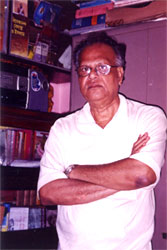
Shakti Chattopadhyay লেবেলটি সহ পোস্টগুলি দেখানো হচ্ছে৷ সকল পোস্ট দেখান

সোমবার, ৮ এপ্রিল, ২০১৯

The Hungryalists by Maitreyee B Chowdhury

The Hungry Poets

By Maitreyee B Chowdhury 
In a city roiled by poverty, immigration, violence and the energy of youthful anger, a new generation of writers staked their claim, says Maitreyee B Chowdhury

In October 1962, young poet Malay Roy Choudhury boarded the newly launched Janata Express at Patna. The train would stop in Delhi before it reached Calcutta—a rather tedious journey that would go on for over two days. Malay hoped Calcutta would be pleasant this time of the year. His elder brother, Samir, had written to him just before he had left for Calcutta. You’ll reach just in time to see the city being decorated for Durga Puja. Ma arrives in the most beautiful colours and people make the most creative podiums for her to be worshipped in. The kashphool would have spread its abundance. You’ll find them everywhere if you care to look, spread out sleepily in the emptiness outside the city. The sound of dhak will be everywhere and if you’re lucky, you’ll find some of the dhakis at the Howrah station when you arrive. Malay wondered if Calcutta had changed Samir. Patna was dry and without a trace of chill. The narrow seats and the stale air that greeted him in the third-class compartment were terrifying. He was carrying two small bags, his underwear peeking out of one, some papers and a few packets of crisps from the other. It was still early evening, with reluctant bogies idly basking in a gentle sun. It was Malay’s first trip to Calcutta after the establishment of the Hungry Generation.

Before the year would end, Malay would meet American poet Allen Ginsberg in Calcutta. It was February 1961 when Ginsberg landed in Bombay. A nuclear face-off had just been averted in Cuba and Delhi was at loggerheads with Peking—a border dispute had pushed the two countries to the brink of war. And just like everywhere else, poets, writers and thinkers in India too were affected by these events.
City for Poets | Calcutta ca. 1945

Ginsberg visited many places in the country, including Benares, Patna, the Himalayan foothills and Calcutta. During his trip, he spent most of his time mingling with like-minded poets, musicians and artists, and later wrote about them in great detail in his Indian Journals. In Calcutta, between keeping company with Ashok Fakir in ‘Ganja Park’—an area near the main road stretching from Chowringhee to Rashbehari Avenue—and hallucinating at Kali’s feet while lying in her temples, Ginsberg would walk around the city or watch bodies being burned in the ghats. To the ever-sceptical Bengali, he might have seemed like just another disillusioned westerner doing the rounds of holy Indian cities, in search of drugs, sex and ‘exotic’ spirituality. Not many Indians at the time were aware of Ginsberg’s reputation or the influence he wielded back home. Ginsberg, of course, had read ‘Howl’, his legendary poem, at Six Gallery in San Francisco by then, and had begun shaping the American approach and reaction to poetry. What effect his presence would have on the poets in Calcutta, or they on him, time would tell vividly. But for now, he was one of them—a poet and a wanderer, who carried with him a turbulent and disturbed past, with the belief that here, of all places, he would be accepted no matter how dirty or disillusioned he was.

The train moved slowly, as if struggling with a natural inclination for inertia. Malay remembered what Samir had written to him from Calcutta while he was in Patna. He had been angry with their father for sending him away to Calcutta after school. The Roy Choudhurys had decided to move from Imlitala, their Patna neighbourhood, which their father considered a bad influence on the boys. Pretty early on in life, the place had exposed them to free sex, toddy, ganja, and much more. Their father had built a new house in Dariapur and the family had shifted there. Subsequently, when Samir was sent to Calcutta, it was a double blow for him, to be removed at once from Imlitala and his family. Calcutta was a city he knew almost nothing about. His instructions to Malay had been clear—he was going to live vicariously through his brother in Patna. On certain days, Samir would almost be pleading with Malay in his letters.
Fraternity (Standing, from left) Saileshwar Ghosh, Malay Roychoudhury, Subhash Ghosh; (seated) Subimal Basak, David, Basudeb Dasgupta
Fraternity: (Standing, from left) Saileshwar Ghosh, Malay Roychoudhury, Subhash Ghosh; (seated) Subimal Basak, David, Basudeb Dasgupta
Dear Malay,

Near the chariali next to our house is a woman who sells bidis for two annas. Buy a packet from her, hide it in your trunk and bring it for me when you’re in Calcutta. Remember, nobody should know about this.
Dada
And another about a month later read:

Dear Malay,
Apparently, there are many things to do here, but I don’t know where to start. I have made a few friends; we meet at the Coffee House regularly. Deepak [Majumdar], Ananda [Bagchi] and Sunil [Ganguly] are close to me. Sometimes we discuss kobita [poetry], at other times, it is the state of affairs. Everyone is angry here; there are strange people I meet on the road. Theyare not like the poor of Imlitala; they have a lost look about them. They don’t look or feel poor when you talk to them—all you can understand is death on the inside. I think they have lost a dream. It makes me feel horrible; I miss the easy poverty of Imlitala . . . You must go to Bade Miyan’s paan shop at the end of our lane and tell him about the paan that I used to have, hewill know. You could have one yourself, but I fear it might not be good for you. You must bring one for me though. It will cost you one anna.
Dada

Malay could not understand from Samir’s letters whether he was happy in Calcutta or not. But he sensed some anger. He seemed like a revolutionary without an understanding of what his revolt was about. Malay wished Samir knew how much he wanted to see Calcutta—this city where poems were read aloud on the streets; where a Shankha Ghosh, even at the height of his literary career, could be approached by college students; where Shakti Chatterjee would recite poetry on the stairs of the Coffee House. Samir’s shift to Calcutta indirectly helped Malay in many ways. It was Ashadh of 1952 when Malay next received a letter from Samir. It had been raining for two days and the blue inland envelope was wet when Malay fetched it from the letterbox. Unlike his previous letters, Samir sounded excited in this one—it was the first time he had forgotten to mention Imlitala.
Dear Malay, 

Last evening, Sunil, Shakti and Deepak came home. My room is small, and the bed has too many books on it for me to move them. We sat on the terrace adjoining my chilekothar [an attic-like room]. While it didn’t matter to either Sunil or Deepak, I was glad I had the small mat Ma had insisted I bring from Patna. Tha’mma doesn’t stir out of her room after dusk, so it was OK for Sunil to bring his smoke. Thanks to the gondhoraj lebu plant that is full of flowers and small bulbs of lemons, the smell of smoke was confined to the terrace. We talked for a long time; thankfully, none of them were in a hurry. Tha’mma might ask a lot of questions tomorrow though. Sunil is full of ideas; he says he wants to start a magazine. He is still not sure how to go about it though, but he says he is bored of reading the same kind of writing. I told him what you and I have talked about so many times. He seemed a bit surprised at first, and then asked me about you. Deepak was quiet all evening, but he sang a song later. Kaka came up to meet us. Later, he and Deepak talked about Hindi film heroines. Their discussion made Shakti and me laugh a lot. There was not much to eat, but Sunil had bought some pakoras on the way; we ate them and, later, licked the plate clean. Sunil went through my books and wanted the [Victorian poet, Algernon Charles] Swinburne collection. I can give it to him only later, which is what I told him. I hope he didn’t take offence though.
More later,
Dada 

Many new writers were Samir’s classmates in City College. There were other established ones, Coffee House regulars, whom Samir had befriended and would discuss literature with. Shakti and Sunil came up quite often; they were close friends, who had been to his family home in Uttorpara a few times. Sunil was a prolific and acclaimed novelist, but poetry was his first love. Indeed, Samir, who’d recognized his talent early on, went on to fund and publish Sunil’s first book of poems, Eka Ebong Koyekjon. Samir would have intense discussions with Deepak, Sunil and Shakti on many an evening on the kind of literature they had all grown up with and began to believe in. Subsequently, he got deeply involved with Sunil in establishing Krittibhash—a journal that launched many a Bengali poet at that time. Deepak, Ananda and Shakti were also compatriots in this venture. Krittibhash found its voice in 1953. Samir always kept his brother in the loop, and Malay would occasionally receive large paper packets containing literary periodicals and books of poetry. Now as the train moved towards Calcutta, Malay felt as if his life was coming full circle. It had been a strange decision to visit the city at a time when post-Partition vomit and excreta were splattered on Calcutta streets. Marked by communal violence, anger and unemployment, the streets smelled of hunger and disillusionment. Riots were still raging. The wound of a land divided lingered, refugees from East Pakistan (now Bangladesh) continued to arrive in droves. And since they did not know where to go, they occupied the pavements, laced the streets with their questions, frustrations and a deep need to be recognised as more than an inconvenient presence on tree-lined avenues. The feeling of being uprooted was everywhere. Political leaders decided that the second phase of five-year planning needed to see the growth of heavy industries. The land required for such industries necessitated the evacuation of farmers. Forced off their ancestral land and in the absence of a proper rehabilitation plan, those evicted wandered aimlessly around the cities—refugees by another name.

Calcutta had assumed different dimensions in Malay’s mind. The smell of the Hooghly wafted across Victoria Memorial and settled like an unwanted cow on its lawns. Unsung symphonies spilled out of St Paul’s Cathedral on lonely nights; white gulls swooped in on grey afternoons and looked startling against the backdrop of the rain-swept edifice. In a few years, Naxalbari would become a reality, but not yet. Like an infant Kali with bohemian fantasies, Calcutta and its literature sprouted a new tongue—that of the Hungry Generation. Malay, like Samir and many others, found himself at the helm of this madness, and poetry seemed to lick his body and soul in strange colours. As a reassurance of such a huge leap of faith, Shakti had written to Samir:

Bondhu Samir,
We had begun by speaking of an undying love for literature, when we suddenly found ourselves in a dream. A dream that is bigger than us, and one that will exist in its capacity of right and wrong and beyond that of our small worlds.
Bhalobashajuriye
Shakti 

Malay in Nepal
Malay in Nepal

Patna, October 1961. Shakti and Haradhan Dhara met Samir and Malay at the brothers’ newly built house. Evening crept stealthily on to their shoulders and sat still there. The Roy Choudhurys were still in a transitional frame of mind. The brothers had not forgotten Imlitala—its terrific chaos, the shadows of their childhood and their small house. The new house in Dariapur on Abdul Bari Road looked spick and span, and stupid. “Not a house for me, not for me!” Malay would shout at the walls. But their father would have none of it—in his vision for his family, Imlitala was a matter of the past. Nearby, in Rajendra Nagar, lived Hindi writers Phanishwar Nath Renu and Ramdhari Singh Dinkar. They belonged to the Nayi Kahani and Uttar Chhaya Wadi movements respectively—groups that believed in largely individualistic, urbanistic and self-conscious aesthetics. While Renu was critically acclaimed as among the most powerful and brilliant writers of his time, Dinkar had a huge impact on readers of Hindi poetry. He went on to become a renowned poet of national standing. His poetry, a precursor to the A-Kavita movement, would later emerge in the sixties as a contemporary influence, inspired in some ways by Ginsberg and the Beat journey. Samir’s regular interactions with them would leave a deep impact on his thinking and mould his poetry in the future. Sometime later, Dinkar, who belonged to the community of Bhumihars, would abandon his caste to make an important statement on caste politics.

It was nine in the evening; dinner was over. None of them had ventured out all day. Malay insisted that Shakti visit Imlitala with him: “I miss Naseem Apa—her fragrant hair, the curve of her back, the way she ran after I kissed her hazaar times in the shadow of the imam. Shakti, come with me to see her, won’t you?” Shakti was overwhelmed by the romanticism of a ghetto being named after a tree. He had been eager to see the imli tree after which Imlitala was named. “Will there be an enactment of Radha–Krishna’s sharad purnima rasa dance?” he asked. “Did the imli tree have a golden wall after the legend of Krishna turning a golden hue while searching for his beloved Radha, who had disappeared in between their dance?” Malay was amused. He had not witnessed any religion in Imlitala. Everyone born there was sworn to poverty, their only allegiance was to the mad dance of filth around them. He told Shakti, “Would you like to read your poetry during the Imlitala fest? Small-time thieves, prostitutes and roadside urchins make up the audience. Women in pink blouses and green petticoats sit down with their men to have country liquor, one hip bent on another, and with dirty hands touch each other. Some love will flow, some lust too. You’ll need a different lens to be able to see this poetry.” Samir sounded a warning that the police might be there too. “Wherever poetry is, the dogs follow,” Malay quipped. A round of laughter followed.

Excerpted from The Hungryalists, forthcoming from Penguin India. Published in the Jan-Mar 2019 issue.

বৃহস্পতিবার, ১ নভেম্বর, ২০১৮

Farzana Versay : Street Messiahs


Space is being occupied. What does that space stand for? What does its occupation convey? There are questions being asked about how non-violence can sustain such protest when it is sought to be quashed even in America. Can people from disparate cities with different needs find a common ground besides the one they sit in?

Robert J. Shapiro, former U.S. Under-Secretary of Commerce for Economic Affairs, wrote: “For the United States it means a middle-class warfare. When middle-class Americans turn to Washington, they see the resounding success of the government’s efforts to stabilise the financial markets – where the top 1% derive most of their wealth. The rich are back to becoming even richer. That’s the way America has operated for at least the last generation. What grates on middle-class Americans this time is that they’ve been getting poorer. And Washington has done little to stabilise the market from which they derive most of their wealth, which is housing.”

Would the middle-class be enthusiastic about the homeless? Can such protests be equalisers? Shapiro demystifies the American fairytale when he says, “There is little controversy among economists that the fabled US ‘land of opportunity’ has become one of the world’s most unequal societies. Using the standard measure (the ‘Gini Coefficient’), America now ranks 93rd in the world in terms of economic equality. That puts us behind places such as Iran, Russia and China.”

Thomas Friedman, after attending a literary festival in India, concluded: “What has brought millions of Indians into the streets to support the India Against Corruption movement and what seems to have triggered not only the Occupy Wall Street movement but also initiatives like Americanselect.org — a centrist group planning to use the Internet to nominate an independent presidential candidate — is a sense that both countries have democratically elected governments that are so beholden to special interests that they can no longer deliver reform. Therefore, they both need shock therapy from outside.”

The comparison does not quite work. India, the upstart Big Brother, is trying to clean up the system. It appears to be more organised. But when dissent is systematised it is in danger of a limited transition. Or, rather, a transmigration of sole interests. The “outside” is rarely the philosophical outsider anymore.  It might be noted that recently when the Mumbai stock exchange at Dalal Street attempted to mimic OWS, it fizzled out within hours. As for shock therapy, was that not the ‘change’ mantra? Does change alter fossilised political dynamics?
* * *
“Sir, yesterday sunrise. He was lynched by a mob.” The poet would not sit in a colour-coordinated rally, or fast, or give a call to fill up the prisons.  He would not get a stamp of approval from the big powers. He was not a neo-Gandhi, yet they called him a violent Gandhian.

Remonstration then was not prefixed with words like “peaceful”. They did not give interviews to news channels or have the support of industrialists. They would spit out with disgust at the very thought. Real expectoration. As the world witnesses India playing to the gallery to fight corruption and prop up the ‘humble’ hero Anna Hazare, I think about the time when dissent was not pretence. Honest protest fuels creativity; it does not live off sound bytes. The current people’s movement is creatively hollow, inspired to protect money garbed as hope.

“I think man has harmed society by first theorising and then putting it to practice. Take the Dandi March, theorise it and start marching again. Everybody knows it is a farce. Culture cannot be theorised; it has to evolve.” These are words from 20 years ago. I was in a middle-class home in Mumbai’s suburbs to meet the pivot of the Hungryalist Movement, Malay Roy Chowdhury, the man who wrote lines that belched out rancid breath from genuinely hungry stomachs.

There was no dichotomy as the smell and sounds of cooking oil spluttering reached us in the modest living room – a sofa, chair, dining table. Was there a dining table? This man did not do the forests of the tribals, wrote no tomes, no sedititious words as precious as Swarovski lisped through elocution English. He did not smile benignly as meetings were disrupted by rightwing groups that throw pamphlets in the air like tinsel on Christmas tree Christs. There was no rightwing enemy then. Just as there was no rubbing of shoulders with the powerful. Everything was the Other.

He could have become a Naxalite and packed bombs with a dynamite cause. He could have packaged himself as an idealist with a full head and sore feet and pole-vaulted his way into the land of the never-say-die dead. He didn’t. He continued to write verse about blood, gore, the nether regions, the lesser regions. But he also worked in a bank. And he was not hungry anymore, even though his past was tied up with the entrails of impotent anger. A past whose hypodermic needle was rusting, but was a reminder of those high, high days, the withdrawal symptoms, the cold turkey.

Around the time when the 50s were being buried, and Allan Ginsberg was shedding his clothes to become a benchmark of sorts, a group of young men in Kolkata (Calcutta then) who wrote poetry in Bengali and rubbed their hands in the mud, formed the Hungryalist Movement. It shocked the lyrically-sanctioned lethargy. The Hungries were about a counter-gluttony culture, but the name had a deeper meaning meshing Chaucer’s “the sower hungry times” from the Canterbury Tales and Spengler’s theory that every culture is a wheel that goes up on its own but on its way down degenerates and starts eating up other cultures. “1 saw this as the hungry element. A realism based on hunger for a culture, by a culture,” said Malay.

Hungryalist poetry was considered hysterical, but then it was striving for complete freedom even from the technicalities of poetry. So it was that he wrote, “I’ll kick all Arts in the back and go away.” It wasn’t vacuous bravado. The group got involved in what appeared as bizarre activities. They wanted to do away with politesse; the fart and barf were publicly emanated. Even Time magazine in its issue of November 20, 1964, could not help commenting, “To let loose a creative furore the Hungries last summer sent every leading Calcutta citizen — from police commissioner to wealthy spinsters — engraved, four-letter worded invitations for a topless bathing suit contest.” It might seem that the motive was to strip hypocrisy. Malay, however, recalls it differently. “None of us thought of protesting, of trying to improve society, but our writings were like that We got branded as anti-establishment and that was the first good thing that happened to Bengali poetry!”

But not too good for him. The whole lot of them were arrested for conspiracy against the state, against society, for corrupting minors, and Malay had a special charge against him — for obscenity. While the others were released, some of them even testified against him. He had to wait for the High Court to acquit him. It could cause a flutter in the household of anyone. Malay, then single, went through the ache of watching his father stand by him helplessly as the police broke open his mother’s steel trunk. His parents had never been to school. “All of us in the Hungry Movement were first-generation literates, from the lower income group.” Discovery of culture came by eating what others spread before him. Hereditary link went back to a grandfather who painted kings and queens.
That other grandfather of every Bengali did not influence him at all. “You cannot think of us in terms of Tagore because he was a billionaire… Our ethos and empathies were completely different not only from Tagore but from the later poets. When we came, we brought things from ourselves. which were different from both Bengali culture and western culture. So we were not immediately acceptable.” For all its rawness, the poetry bled purposefully: “Spread out your matrix. Give me peace.”
Was it fear of the self more than a fight that they knew would never be finished? “Today the images and words are violent, reflecting the situation, things which are not acceptable to human decency. But, yes, there was a tendency at that time to please the reader. But when we started we began questioning ourselves: why should we please the reader, why not shock him? He’ll remember you.”
The authorities then could also have seen a devious purpose — political uprising — in all that the Hungries wrote. A literary critic had said of Malay that even his love poems were political. “Everything in life can be interpreted in every way. See. You may not be a believer in god, but your sense of fear, your longing for something could be interpreted as a belief. Some critics are more inclined to interpret things for political purposes. Anyway, nobody does anything internationally apolitical.” Yet, he did not call himself political, living in the “cloaked melon” of an ideology. “We were cultural outsiders. We brought to Calcutta certain things that we got from outside.”

The Hungryalist Movement was not to set up something on the fringes. but to fight for a place within the culture that was nibbling away at anything that met its gaze. Therefore, the sidetracking was not exactly palatable. He was not invited to official functions. “I missed out on a large audience. After I was convicted all my friends left me. It became very difficult to get my poems printed and I also gave up writing. Meanwhile, I did not think of literature at all and kept busy playing with my children.” The revolution had come full circle. The man who used to roam the interiors of the country, staying with farmers and sleeping on the hard floor when “living was more important than poetry”, found it increasingly difficult to do so. He realised that he had to guzzle bottled fizz because drinking tap water gave him an upset stomach.

It was the candour of someone who had experienced “Million glasspanes are breaking in my cortex”. What changed? Ennui? Apprehension?  “The establishment made me like that – now I feel I am a confused man.” It was a confusion generated by what was between the lines, “The third person influencing you without allowing you to think. It is impossible to decide after a point what should he done within the structure itself.”

Did the comfort of a suburban home and time spent with family bring a sense of peace or was there regret? “A lot of my friends became Naxalites but I did not join them because that sort of revolution was not acceptable to me. As for the establishment, it is also part of culture and its degeneration.” In the process of growing are painful moments when you have to shed a few things, disown others. Do you swallow the venom? Was Hungryalism still relevant to him? “I know I have changed, my poems have changed. Now it will be a fraud to call myself a revolutionary.”

There are people walking down the streets, sitting around campfires. People remember the flaky words of quivering voices, immortalised by cocooned dissent. Malay did not take that road and preferred to ask in a poem, “Shall I put on the shirt? Gulp few morsels? Slip off through the terrace?”
Rebellion is a robot now as the system and the counter-system peek into dark crannies and pull out those who can be taken in. Malay’s words seem apt, “The metropolis burn/ A naked priest elopes with Shiva’s phallus.”

সোমবার, ২৯ অক্টোবর, ২০১৮

Hungryalism and Srjit Mukherji's film 'Baishey Srabon'


Unmitigated Agonies and Unheard voices: Exploration of Madness in Srijit Mukherji’s Baishey Shrabon and Jatishwar

September 5, 2015 | By

In  Baishe Srabon Srjit Mukherjee reflects on ‘mad’ characters and how they are treated by the society at large – for its use and desertion.
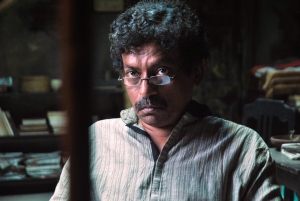
The mad poet (played by director Goutam Ghosh) in Baishe Srabon

Srijit Mukherji has been one of the most prominent contemporary film makers of Tollywood in recent years. Placing himself against the contradictory trends of Commercial and Art Cinema, he has tried to create a seamless fusion between them and has quite successfully been able to do so in films like Autograph, Baishe Shrabon, Jatiswar or Chotuskone. Srijit’s films happen to be a refreshing break from the banal platitudes of commercial films; however they seldom tend to go overboard with lofty, esoteric messages.

The themes and motifs that Srijit’s films explore, despite not being unfamiliar to Bengali Cinephiles, carve a niche substantially because of the manner they are dealt with. Despite the occasional forays into the world of death, gloom and depression they barely recreate a Sen or a Ghatak on screen.  Be the use of cinematic mis-en-scene or the delicate use of songs or the use of camera, Srijit always keeps the populist veneer intact through a unique stylization of the cinematic narrative. His penchant for excessive stylization helps him in getting a wider audience, across different age groups, predominantly the youth, nevertheless at times it becomes grossly superfluous and grates on one’s nerves.

A critical appraisal of Mukherji’s films, however, unfolds some common thematic aspects. Madness is a motif, Mukherji, has frequently dwelt on in his films. After Foucault it is well known that the idea of madness is a discursive construct. Deviation from the socially disciplined discourses tags one with the charge of madness. Srijit’s films obviously delve deeper into its exploration of madness to reveal how the identities of the so called mad characters are structured by the politics of power.
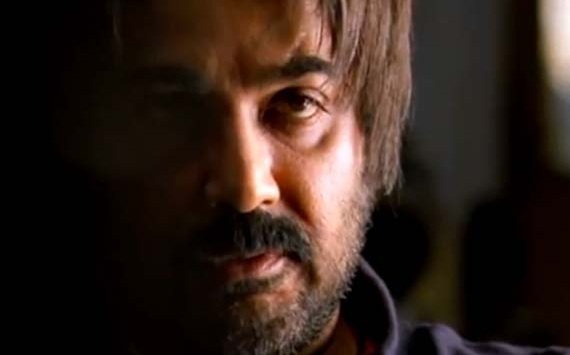
Prosenjit as Prabir in Baishe Srabon
If we look at Baishe Srabon Srijit’s most commercially successful film, Srijit ventures into a completely unexplored territory through his references to Hungryalist Poetry. Hungryalism was famous for its iconoclastic worldview, informed by its deep-rooted anguish and rebellion against the conventional system.  ‘Hungry Generation’ is one of the lost and least acknowledged poetic traditions in the realm of Bengali poetry ushered by Malay Roy Chowdhury, Shakti Chattapadhyay , Sandipan Chatterjee, Binoy Majumdar and others.

Firstly Srijit’s success lies in rescuing it from the Bengali cultural amnesia. The cinematic narrative becomes intertexual with reference to Nibaran Chakrabarty from Tagore’s Shesher Kabita.  Nibaran is projected as a deranged poet with the delusional worldview. Metaphorically, however, Nibaran’s narrative seems to explore the politics of mainstream Bengali Neo-Romantic poetry in suppressing the voices of dissent emerging from the margin. Hungry Realism’s obsession with crudity and vulgarity, moving away from the mushy sentimental narrative of Bengali Romantic poetry, was perhaps too scathing for the Bengali readers to endure.

Simultaneously, another narrative shows Prabir Roy Chowdhury, an ex police officer as one of the victims of the system.  Prabir’s attempt to rise above the administrative loopholes makes him a victim of the system; he is suspended from the job being indicted with the charge of ‘madness’. Prabir’s resistance to be in complicity with the corrupt logic of the system tags levels him with the charge of madness to ostracize him from the system. But the twist comes when a series of murderers in Kolkata leaves the Police Force utterly confounded. They are forced to seek resort to the fertile brain of Prabir again to resolve these problems.

The narrative of a mad poet and a mad Police officer move together and coincide at a crucial juncture from where the film takes its climactic turn. The conversation between Prabir Roy Chowdhury and Nibaran Chakrabarty clearly explores the perversions of power and shows how they remain integrally embedded within the system. Their attitude to go against the grain whether it is through writing poetry against the popular stream or refusal to be in complicity with the corrupt bureaucratic system represents a form of transgression beyond the socially disciplined discourses. Baishey Srabon thereby very pertinently calls into the question the idea of madness and explores it to be ideologically governed.

The trope of madness is quite adroitly used in Srijit’s Jatishwar as well which is also one of his most critically acclaimed films. However its commercial success didn’t touch the height of Baishe Shrabon. Baishe Shrabon being a whodunit is made up of a series of interconnected cues, in which Bengali poetry plays a salient role. Though Srijit brilliantly arranges the plot with reference to the poetry of the ‘Hungry’ poets, the main narrative revolves around the search for the murderer as in a perfect whodunit. The way Prabir searches information about the poets on Google, it becomes pretty apparent that they are nothing more than forgotten faces in Bengali poetry. Though these references almost resuscitate an alternative poetic tradition through a popular medium, the reference to Bengali poetry remains tangential to the main narrative. It only provides the main plot its contours without coming in contact with it.

মঙ্গলবার, ১০ জুলাই, ২০১৮

Sunil Gangopadhyay sabotaged the Hungryalist Movement

It was Sunil Gangopadhyay who sabotaged the Hungryalist movement of Literature and Culture in West Bengal. When the movement gathered steam at Calcutta in special and India in general, he was in Iowa, USA for learning how to write poems. His friends kept on writing him that the Hungryalists have arrived as a potent force in Calcutta's cultural and literary scene and they are being highlighted in the Bengali and English dailies and periodicals, inasmuch as the daily 'Jugantar' had written editorials on them and cartoons were being published in main Bengali and English newspapers and headlines were appearing in Bengali broadsides against the Hungryalists to provoke the Establishment and the Police.  Several literary periodicals had started writing about the Hungryalists which had never happened earlier in the history of Bengali literature and culture.

Sunil Gangopadhyay, who was associated with the Establishment lobby started writing angry letters to Sandipan Chattopadhyay, Shakti Chattopadhyay, Utpalkumar Basu so that they leave the Hungryalist movement immediately. He also wrote a letter threatening Malay Roychoudhury that after he returns from USA he will see to it that the Hungryalist movement is dismantled.

Sunil Gangopadhyay returned from USA and Police filed charges of conspiracy against the State and Obscenity in Malay Roychoudhury's poem Stark Electric Jesus ( Prachando Baidyutik Chhutar ). Eleven Hungryalists were served with arrest warrents and six Hungryalists viz, Samir Roychoudhury, Debi Roy, Malay Roychoudhury, Pradip Choudhuri, Saileswar Ghosh and Subhash Ghosh were arrested. Malay Roychoudhury being the leader of the movement was handcuffed, a rope tied to his waist and he was forced to march from lock up to Court along with several criminals, an event unknown in the history of literature. 

Sunil Gangopadhyay went on to become a powerful literary personality in the Indian Government's Literature Academy and bestowed the highest prizes to Sandipan chattopadhyay, Shakti Chattopadhyay and Utpalkumar Basu for having ditched the Hungryalist movement. These three writers became Police witness against Malay Roychoudhury in the Court Case against Roychoudhury's poem Stark Electric Jesus. Roychoudhury was sentenced for a month for the testimony of these witnesses in the Calcutta Court.

Sunil Gangopadhyay went to the extent of writing an editorial against the Hungryalist movement in 'Krittibas' magazine. It is really a travesty of literary history that 'Krittibas' magazine was funded by Samir Roychoudhury, one of the founding fathers of the Hungryalist movement and a member of The Hungryalist Quartet.

শনিবার, ৭ জুলাই, ২০১৮

These Four Founders of The Movement are known as "HUNGRYALIST QUARTET"

                                                             Malay Roychoudhury
                                                                          
                                                            Samir Roychoudhury
                                                                           
                                                            Shakti Chattopadhyay
                                                                          

                                                                  Debi Roy