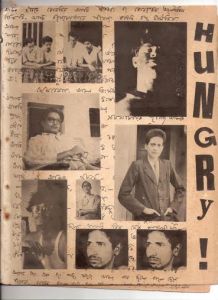
রবিবার, ১৮ মার্চ, ২০১৮

Art, Hungryalist Movement and Beats by Juliet Reynolds


Art, the Hungryalists, and the Beats

By Juliet Reynolds
As both movements were predominated by poets and writers, there can be few to argue with the established perception that the Beat Generation and the Hungry Generation were primarily literary in character. While the two movements have tended to invite comparison with the Dadaists, no-one would define either as an ‘art movement’, as Dada so patently was, its literary associations notwithstanding.
Yet a closer look at the history and legacy of the Beats and the Hungryalists reveals beyond doubt that visual art and artists occupied a more pivotal place in their movements than is generally supposed. This seems at first reckoning to be truer of the Beat movement, whose annals contain a riveting art narrative that runs from their very beginnings and has barely come to a stop. Of course, it must be borne in mind that Beatdom is much better documented and appraised than Hungryalism, thanks in the main to the First World-Third World divide.  While the Beats’ counter-culture evolved in the most powerful nation on earth, the Hungryalists’ took shape in an impoverished, underdeveloped country, that too in a single state or region.
Moreover, Hungryalism was politically suppressed in a way and to an extent that Beatdom was not. Ginsberg, Kerouac, Ferlinghetti, Corso, Burroughs and the rest could turn their notoriety to advantage, even if they didn’t desire it.  This would allow their movement to endure and evolve so that it would live on in the collective consciousness and become a cult.
On the other hand, the movement launched in 1961 by Malay Roychoudhury, Shakti Chattopadhyay, Samir Roychoudhury and Debi Roy was decimated within a few years due to official hounding as well as internal strife, a good deal of it fomented precisely because of the harassment. The prosecution of Malay and others for obscenity and his subsequent imprisonment was but part of the Bengal administration’s crackdown on Hungryalism. Booked for conspiracy, every member of the group was subjected to ruthless police raids resulting in the confiscation of their intellectual and personal property, including books, writings and letters. The Hungryalist artists – Anil Karanjai, Karunanidhan (Karuna) Mukhopadhyay, and others attached to their studio in Banaras, named the Devil’s Workshop – witnessed the seizure of their art works and all
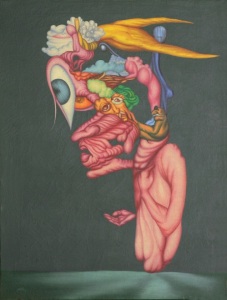
Anil Karanjai, The Dreamer, 1969
records of the movement, never to see their restitution. Fortunately, a body of Anil’s work, created in the immediate post-Hungryalist era, remained in his hands or became part of collections, and because the imagery this encompasses is strongly marked by the ideas and concerns of the movement, it provides the basis for a more comprehensive understanding of Hungryalism. It’s not a cliché to state that images so often speak more eloquently than words.
Just as Anil Karanjai (1940-2001) was the only adherent of the Hungry Generation to dedicate his life to art,
 Portrait of Allen Ginsberg               by Robert LaVigne, c. mid-1950s
Portrait of Allen Ginsberg by Robert LaVigne, c. mid-1950s
there was a sole true Beat painter, Robert LaVigne (1928-2014). As recorded by Allen Ginsberg, LaVigne had helped give birth to the Beat Generation.  The artist’s roomy house in San Francisco was a gathering place for the wild, unclothed ‘bohemians’ of all genders who personified the movement. LaVigne did graphics and poster art for the group, as well as producing his own paintings. Anil and Karuna worked similarly with the Hungryalists.
Ginsberg and LaVigne shared aesthetic concerns. They both focused on themes of decay and death reflecting the angst of the young generation in the Atomic Age which, to quote LaVigne, ‘gave the lie to permanence’.  The question of creating durable art in a world with no future had a paralysing effect on him, a state he might not have come out of had he not discovered Beatdom. ‘The mad, naked poet’, as Ginsberg was known, and ‘the naked, great painter’, as Ginsberg

Girl
Sketch of a Young Girl, Anil Karanjai 1991
described LaVigne, both created telling portraits of friends and intimates, the former searingly in ‘Howl’, the latter more gently in lines and colour.  His oil portrait of the young Ginsberg illustrates this amply.
In contrast to his Beat counterpart, Anil Karanjai came to portraiture quite late in his life. Stylistically, the two artists are at variance but in several of their portraits there is a similar expression of tenderness for the subject. This is much in evidence, for instance, in Anil’s charcoal sketch of Karuna’s young daughter, a girl Anil had known since birth and who had been almost a mascot for the Hungryalist artists.
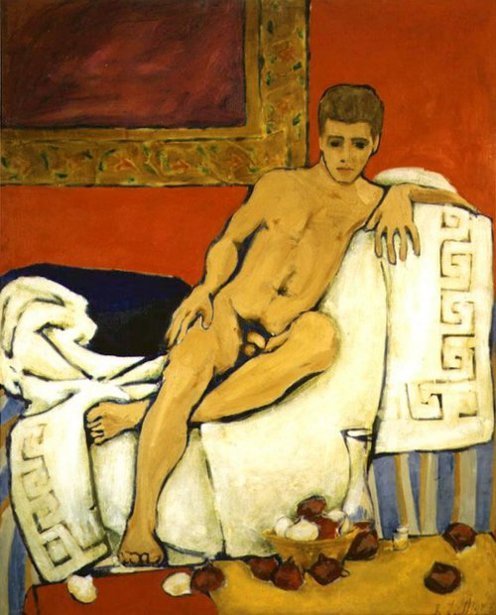
Portrait of Peter Orlovsky by Robert LaVigne, c. mid-1950s
                Portrait of Peter Orlovsky by Robert LaVigne, c. mid-1950s
Ginsberg’s favourite work by his painter friend LaVigne, also his rival in love, was a huge portrait of the young Peter Orlovsky. Naked with an uncircumcised penis and crop of dark pubic hair, the work is sexually charged but it is also sad and contemplative. Ginsberg wrote that when he first saw the portrait, before ever meeting the subject, he ‘looked in its eyes and was shocked by love’. By the standards of the day, Ginsberg and LaVigne were both pornographers. But unlike the poet, the painter managed to evade prosecution, a remarkable feat given that full-frontal nudity was deemed obscene until the early 1970s and homosexuality was a cognizable offence.
Like Robert LaVigne, Anil Karanjai painted nudes, without legal repercussions.  But, as may be remarked in his romantic canvas ‘Clouds in the Moonlight’ (1970), the Hungryalist was more of a visionary than the Beat painter.
Anil Karanjai, Clouds in the Moonlight, 1970
                                               Anil Karanjai, Clouds in the Moonlight, 1970
The grand poet and co-founder of City Lights, Lawrence Ferlinghetti, who was charged with obscenity for publishing ‘Howl’ and who published the Hungryalists when they were standing trial, was also a painter of considerable accomplishment. Ferlinghetti’s expressionistic imagery – the earliest semi-abstract, the later figurative and often directly political – is very compelling and underlines his deep commitment as an activist.
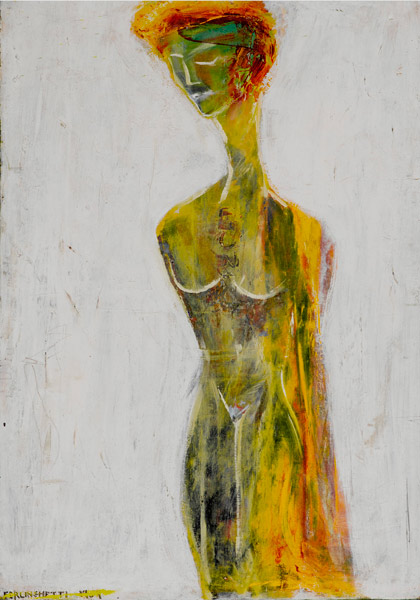
Lawrence Ferlinghetti, Against the Chalk Cliffs, 1952-7
             Lawrence Ferlinghetti, Against the Chalk Cliffs, 1952-7
The prosecuted author of ‘Naked Lunch’, William Burroughs, is a further major figure of the Beat Generation to have been a visual artist. But the paintings and sculptures of Burroughs are literal horrors. He was known at times to have painted with his eyes shut in order to explore his psyche, which was considerably deranged, not just by an overload of hard drugs and perverse sexual drives. Some of his canvases are riddled with bullet holes, a reminder to his viewers that he shot his wife to death while playing William Tell, mistaking her head for a highball. Later known as ‘the father of Punk’, Burroughs enjoyed a friendship with the ‘father of Pop Art’, Andy Warhol, himself no stranger to guns, even if as victim rather than shooter. Burroughs was a frequent visitor to Warhol’s New York studio, known as ‘The Factory’.
In their earlier days, the Beats were loosely linked to the Abstract Expressionist painters and although the latter were not quite so flagrant in their unorthodox personal lives, they shocked the media and public in equal measure when it came to their work. They also created in a similar vein, eschewing conventional art forms and expressing themselves spontaneously; to achieve this end, they applied rapid, fluid strokes on outsized

Anil Karanjai, Summer Morning (detail) 1971
canvases; this was consistent with ‘the orgasmic flow’ that was a lynchpin of Hungryalism. Abstract expressionist paintings may appear anarchic but, in common with the writings of both the Beats and the Hungryalists, their art was conceptual in construct; in essence, their chaos was planned.
The image of the artist creating in a frenzy of uncontrolled passion is but a cliché, and few painters underlined this more cogently than Anil Karanjai. Even as a neophyte, full of fury and restless energy, he produced painstaking, considered work. If anything, his experience with the Hungryalists, among whom he was one of the
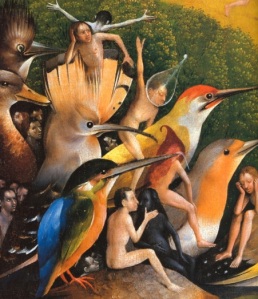
Hieronymus Bosch                                   The Garden of Earthly Delights (detail) late 15th-early 16th century
Hieronymus Bosch The Garden of Earthly Delights (detail) late 15th-early 16th century
youngest, served to heighten these qualities. The only western painter to have influenced him in any way was the Dutch master, Hieronymus Bosch (c. 1450–1516). Bosch’s grotesque satirical imagery inspired Anil as he struggled to create his own unique vision of the hierarchical, oppressive society around him. Abstract Expressionism was unknown to Anil until much later on.
The most notorious Abstract Expressionist, Jackson Pollock – ‘Jack the Dripper’ – likewise an ‘action painter’, is one of several artists who finds a place among the writers at The American Museum of Beat Art (AMBA) in California. So too is the supreme Dadaist, Marcel Duchamp, who had coined the term ‘anti-art’ before any of the Beats were born and was, therefore, one of their idols. But the story goes that when Allen Ginsberg and Gregory Corso met Duchamp in Paris in the late 1950s, they were so inebriated that the former kissed his knees while the latter cut off his tie; by now an elder of the art world, Duchamp was probably not amused. The Beats’ conduct in those days could be so selfishly outrageous that they managed to antagonise many, including Jean Genet, hardly known for model behaviour himself.
It’s doubtful whether the subject of art arose in a meaningful way between Anil Karanjai and Allen Ginsberg when they spent time together in Banaras. The American had his mind on ‘higher things’, namely sadhus, burning ghats, mantras and ganja. Apart from introducing Ginsberg to the harmonium, in the company of the Buddhist, Hindi poet, Nagarjuna, Anil and Karuna taught Ginsberg and Orlovsky the art of chillum-smoking, an almost ritualistic activity, not at all easy to master. Otherwise, Ginsberg appears to have shown little curiosity about the art of the Hungryalists. This did not offend Anil who was then very young, thrilled to have the opportunity to converse in English, a language with which he was not then familiar. Neither Anil nor Karuna would have been overawed by the feted American, but Anil would sometimes quote him later: “America when will you send your eggs to India?”, from the poem America, was a favourite line.
Ginsberg no doubt was not a racist, not at least on a conscious level. But there was an element of white man’s arrogance within him, as there surely was in other Beats. Despite being an anti-establishment movement, it was at some levels a highly elitist one as well. Burroughs, for example, seems to have got away with his wife’s killing because he was a Harvard alumnus and came from a rich family. The background of Ginsberg was not quite so privileged but he rose to superstardom young. No amount of ‘slumming-it’ in India could change that, could knock him from his pedestal; in addition, he must have been treated to a fair share of ‘chamchagiri’ during his travels. Probably the Hungryalists were among the few to exchange ideas with him as equals, and his failure to acknowledge their impact on his poetry and thinking reflects poorly upon him.
Ginsberg, who was evidently quite taken by religion in India, may not have entirely appreciated the Hungryalists’ views on the subject. They denounced god and all forms of belief and worship in the most condemnatory of terms. Anil’s upbringing in Banaras had rendered him particularly irreligious; he’d been challenging temple elders since the age of 12, often defeating them with his superior knowledge of the Hindu scriptures and his sharp tongue. With a scientific bent of mind, he would remain a staunch atheist throughout his life.  Early Buddhism did appeal to him, but he was critical of the Tibetan form of Buddhism, later embraced by Allen Ginsberg. Of course, the Beat poet’s anti-war politics and activism did accord with Anil’s worldview, as it must have with others of the erstwhile Hungry Generation.
As far as the Hungryalists’ politics was concerned, Anil was at one with their ferocious attack on the entrenched establishment, but he rejected their anarchism, their precept that existence is ‘pre-political’ and that all political ideologies should be precluded. He had enrolled in and quit the Communist Party much prior to joining Hungry Generation, but he would thereafter remain committed to the far left. It is a myth he became a Naxalite when Hungryalism fizzled out.
There is truth in the legend that the Hungryalists engaged in sexual anarchy in Banaras and Kathmandu, but compared to the shenanigans of the Beats this was really quite tame. Anil and Karuna did live with seekers and hippies in an international commune, and indeed Karuna was its manager and sometimes head cook. Further, a large part of their subversive activities did involve the consumption of consciousness expanding substances including LSD, magic mushrooms and the like, but their experiments were always undertaken in a controlled environment. This did make a great mark on Anil but because he never consumed substances irresponsibly, the outcome was positive, helping to liberate and enhance his vision as a painter. This hardly constituted ‘drug abuse’ as claimed by some.
Further, the deliberate burning of paintings by their Hungryalist creators is a much exaggerated story, largely based on the aftermath of an exhibition in 1967 at a well-known Kathmandu gallery. The event coincided with a writers’ conference that was attended by Malay and others who had remained loyal to Hungryalism. It was Karuna alone who destroyed his work. Anil enjoyed the spectacle but remained on the side-lines. Such anti-art gestures didn’t fit his philosophy. His iconoclasm was of another kind.
Anil Karanjai, The Competition, 1968
                                                       Anil Karanjai, The Competition, 1968
Yet, whatever his divergences with Hungryalist ideology, Anil shared the movement’s aesthetic concerns. This is most immediately perceptible in his works of the late ’60s such as ‘The Competition’. Painted in 52 straight hours in the Banaras commune, the work is based on a banyan tree, a metaphor for the chaos and struggle of the times. It also reflects the aspiration of the Hungryalists, as well as that of the Beats, to reintegrate humans with the natural world, a world in which obscenity is non-existent and lost innocence is restored.
Although Anil’s work metamorphosed and matured in his post-Hungry Generation decades, his experience with the movement remained in his consciousness. His ideas may have come from many sources, but he never lost sight of that Hungryalist goal. Much of his late work is apparently classical, an expression of realism. His landscapes in particular seem to be the antithesis of his early ‘surreal’ imagery and this tends to confound his viewers. But while it is certainly true that the provocative, rhetorical imagery has vanished, the foundations remain the same. From beginning to end, Anil’s art expresses the drama of the human condition through the moods and forms of nature. And this does accord with Hungryalist poetry. Take, for instance, the lines of Shakti Chattopadhyay:
“Like a football the moon is poised over the hill
Waiting for the late night game and the war cries
At these moments you can visit the forest…”
(Translated by Arunava Sinha)

Anil Karanjai, Moonrise, 1990
                                                                      Anil Karanjai, Moonrise, 1990
The poet conjures up an image very close in mood and feeling to a late work of Anil’s, part of a series of mysterious night landscapes. Binoy Majumdar also approaches the spirit of this image when he says:
“all trees and flowering plants stand on their own
grounds at a distance forever
dreaming of breathtaking union.”
(Translated by Aryanil Mukherjee )
The concept of nature’s creations ‘dreaming of breathtaking union’ is echoed time and again in the life’s work of Anil Karanjai.
So too is the theme of the lonely creator or thinker which he expressed with great range. In a canvas of  1969,  titled ‘The Dreamer’, the thinker is
Anil Karanjai, The Builder (watercolour), 1979
shaped by confrontational Hungryalism and LSD, while a work in watercolour presents the theme in a way that parallels a declaration of Malay Roychoudhury: “…for me, the first poet was that Zinjanthropus who lifted a stone millions of years ago and made it into a weapon.” Later, Anil’s solitary poets or philosophers, set in stone, are encircled by nature, their only weapons their knowledge and experience. All these works are executed with mastery. It reflects well on Hungryalism that it is associated with an artist of such calibre and originality.
…
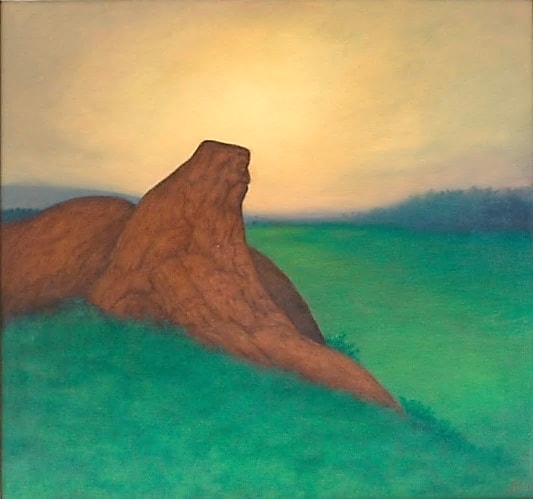
Anil Karanjai, Solace in Solitude, 2000
                                                 Anil Karanjai, Solace in Solitude, 2000
…
*All the works by Anil Karanjai accompanying this piece belong to the collection of the writer, with the exception of ‘The Dreamer’, which is in the collection of Anjana Batra, New Delhi; ‘Clouds in the Moonlight’ is part of the collection of The Kumar Gallery, New Delhi and New York.
…
Bio:
Juliet Reynolds is a critic and writer, specialising in Indian art and socio-cultural issues. Of mixed Irish-English descent, she was born in Ireland and educated in England, France and Italy. A gold medallist from the London Academy of Music and Dramatic Art, she worked for many years as an English and drama teacher with students of diverse ethnicity. Based in New Delhi and Dehradun, she has spent most of her working life in India. Here she has established a reputation as a resolute critic and commentator, and as a bridge between scholars and the lay reader. The publications to which she has contributed include The Spectator, The Insight Guide to India, The India International Centre Quarterly Review, The Pioneer and Biblio. She is the author of In the Eyes of a Rasika: a connoisseur’s view of art and politics, art and science (Srishti/Bluejay, 2003) and Finding Neema, (Hachette, 2013). Her late husband was the Hungryalist artist, Anil Karanjai.
***

Juliet Reynolds on Hungryalism and Anil Karanjai


Excerpts from an interview with Juliet Reynolds

By The Sunflower Collective
Juliet Reynolds, well-known art critic and wife of the Hungryalist painter, Anil Karanjai, met the editors of the Sunflower Collective at her Jor Bagh residence recently for a chat about her husband and his art, the art-world of India in general, and the Leftist politics and its understanding of art. The conversation started with a discussion about a previous post on TSC describing Karanjai as “embittered” towards the end of his life. This is part one of a three part series.
Juliet Reynolds: I was just a bit taken aback by the word ‘embittered’. And I got your point; you clarified it. Anil’s…wasn’t so much embitterment.
Abhimanyu Singh: I understand.
JR: In the Malay interview, that word comes up again. It hit me…
AS: Has Malay da used the word?
Goirick Brahmachari: I think one of the questions had it…
AS: Actually, that’s my understanding from reading the book (Finding Neema). I don’t put a negative value to bitterness. I like Bob Dylan; his songs are bitter. I think any reasonable person will feel bitter with this world because it is unfair.
JR: Bitterness was never really in Anil’s character. He could be very fiery; he would express a lot of rage and anger. But he also had a very soft, quiet side; he would feel sad about it then. There was a sad side to Anil… (almost) melancholic. He would feel deep sadness about things that had gone wrong…and then at times, he’d be furious. Maybe, in a way, there was an element of bitterness…
GB (to AS): I think you had meant to say that his experience was bitter…
AS: Yes.
GB: Not that as a man he was bitter.
JR: Ok, we clarified it now.
AS: He had taken to painting landscapes which were not considered highly in terms of concept.
JR: For him, landscapes were his own rebellion against mainstream art, which was more and more imitating the trends in the West; he always felt strongly about that…art going into post-modernism, installation, he refused to do it.
AS: What is your view on it?
JR: Very rarely have I seen anything (of this sort) which struck a chord in me…emotional or intellectual. Recently, I was at the Royal Academy in London and I saw Ai Weiwei’s work and it was mostly installations. I was skeptical at first… because he is critical of the Communist regime so the West is making him very big…but I recognised that the man really has something, he has originality. Anish Kapoor is a midget in front of him, frankly.
AS: You don’t care much for his work?
JR: No. Highly over-rated.
AS: And Subodh Gupta?
JR: Also highly over-rated. Ridiculous. And it is not particularly new exhibiting bartan and garbage …even people like Vivan Sundaram, from an older generation, a really well-trained, very skillful artist, even he has piled up garbage at the Lalit Kala Akademi.
AS: Do you think identity is being peddled in the name of art?
JR: Certainly, I think there is tokenism. Anil was not only against it … from deep inside his core, he could not do (what others were doing). It did not come from within. If his art did not come from somewhere deep inside him, he wasn’t going to do it.
There were many aspects to his painting landscapes. One was going against the mainstream. But he never protested for the sake of it. He was drawn to landscapes because he liked going into nature. He got a great feeling of solace and comfort from it. There is a film on him…
GB: Which was shown at the Sahitya Akademi?
JR: Yes, and he talks of spiritual loneliness in it. He wasn’t religious though. So that connection with nature he felt. He also wanted to give a contemporary, modern language to landscape while not straying too far from realism. That got him into a lot of trouble. Some called it calendar art. Anil looked at calendar art. He wanted to bridge the gap between high art and low art, to communicate with people. He was not interested in painting only for the elite. He wanted to communicate with as wide a public as possible… (Of course) no artist is going to produce a masterpiece every time. It takes trial and error, experimentation. That happens to every artist. But everywhere his detractors would be saying “aah”, “ooh”…“look at him, he’s painting Lodhi Gardens.” Lodhi Gardens was the closest place where he could be in nature. Like Cézanne, he was exploring the forms of nature, something much deeper, something more rooted; like Cézanne painted that mountain in Southern France (Mont Sainte Victoire) hundreds of times, looking for something, that feeling he would get standing in front of it, how could he capture that feeling?
AS: Do you think he was protesting against the diktats of the Progressive movement and its emphasis on social realism?
JR: He knew about the Modern masters and paid homage to them in his early works. But he was not very influenced by any one artist. Maybe in his early years he liked the old master, Hieronymus Bosch…To be a Modernist, your work had to be full of contortions and distortions; he was also turning his back on that. But it wasn’t just for the sake of it, it was because he felt it also.
GB: It was more organic…
AS/ GB: Tell us about his politics?
JR: The Hungry Generation were anarchists, nihilsts. But Anil did not share that; from a very early stage, he was associated with the Left, the far-Left. I think he became a cadre of one of the mainstream Marxist parties also but they told him that he should wear dirty shoes when going to the people, that he should fill up these forms if he wanted to be promoted up the hierarchy, so he told them to take a running jump.
AS: So he did not favour their dogma and pretences?
JR: Oh no no! Never! But when the revolutionary movement was going on…
AS: You mean the Naxal movement?
JR: Yeah…He wasn’t in Bengal at that time but he would go to Calcutta…. Also, there were student movements going on in Benaras, he was involved in all that. You couldn’t just define him narrowly. Anything which was questioning the status quo, something with solid foundation that could overthrow the status quo, anything of that kind had his support.
To come to Malay, they did not really share politics. Anil used to tell me that he did not really share their politics, anarchism and all that…it was because of the anti-establishment stance that he was part of the movement. And also, the energy and their creativity. He joined them for that. He was a bit at odds with their politics, although not in any major kind of way. But he stuck to them because the Hungry Generation experience for Anil was life-changing. I never realised until much later how much he missed it. In fact, Malay came here once, just once…
GB: In fact, he told me about you and that’s how we got in touch.
JR: Anil talked a lot about Malay after that and how much the movement had meant to him. Anil and Karuna (Nidhan, another Hungryalist painter) were in Benaras at that time, with flower children and hippies…
GB: And the student politics…
JR: Yes, and I don’t know why the Hungry Generation fell apart, maybe there were ego problems…
GB: More than that, I think there were mass-arrests and the government…
JR: …Cracked down on them. But there were some differences between them, between Malay and others…
GB: There are.
JR: Yeah. 

Talking Poetry, Ginsberg and the Hungryalists : Samir Roychoudhury, a retrospective By Maitreyee B Chowdhury


Talking Poetry, Ginsberg and the Hungryalists: Samir Roychoudhury, a retrospective

By Maitreyee B Chowdhury
On one of my recent visits to the city of Kolkata, I had been strolling down College Street, where I picked up an old issue of Krittibas (a renowned poetry journal from Bengal). An entire generation of names tumbled out. Not far from where I stood, a group of students, probably from Presidency College, sat on the side of the road with little cups of tea. One of them read out in a distinct voice. As I stood and listened, poetry seemed to drown everything else. A precursor of sorts I thought, to my meeting next day with Hungry Generation co-founder, Samir Roychoudhury.
I had been carefully instructed to take a rickshaw or a taxi as I might lose my way. I chose to walk instead, meandering through some of the rather neat and obscure lanes inside Tollygunge, where dirty ducks in small ponds appeared terribly busy, talkative rickshaw-pullers forged conversations with unsuspecting housewives, and young men played football in obscure little fields oblivious to a busy world outside. Soon, I found myself in front of the Roychoudhury residence. Samir stood in welcome in front of the gate, chitchatting with the person manning a grocery shop next door.
I reflect on how it seems perfectly normal to be reading and discussing poetry on a weekday morning with the man who had co-launched a poetry movement in Bengali literature in the early sixties – a movement that was lauded by their friend and supporter Allen Ginsberg. Samir Roychoudhury is elder brother to Malay Roychoudhury, the more widely known face of the Hungryalists. He has been behind the bars on account of the poetry that he and his fellow poets had written, and yet in his own words, there was nothing he would have done differently.
I am ushered into the house and given a tour of the space from which much of his writing is done. Lying around the living room are sepia-tinted manuscripts, issues of Haowa 49 (that he publishes), copies of Krittibas magazines, edited by him, magazines where his poetry has been published, his books and much more.
While talking to him, it is easy to forget that Samir is an important part of a movement that gave a new vocabulary to Bengali literature, taught new reading habits and made the stench of the road, among other such ‘un-poetic’ things, poetic. But being word-drunk is an equalizer. Like an indulgent guide, he takes me through the memory lanes of Patna and Chaibasa, places that nurtured and gave wings to the Hungry Generation movement. Once in a while, he wanders away from the objective of the movement, and instead shares personal anecdotes that are more telling in fact: how one writes a particular poem, deletes another, curls around a friend’s verse and finds a different middle to start off with. Samir is slow in his movements now; he keeps drifting off into the past, coming back to the present with some hesitation and picking up a poem that he has recently started on. There is evident joy, pride and some amusement in such sharing. He dwells briefly on the fact that the work of the Hungryalists was different both in content and style, and then goes on to elaborate how the movement became an expression for those frustrated with the culture and ethics of those times. In that sense, the Hungryalists perhaps spoke for an entire city affected by post-Partition poverty politics. New conversations and a new language became the need of the day – a language that would cast aside elitist aspirations and speak of angst, instead.
Oh, Sir, nobody uses the Jadavpur subway for a road crossing
During night aristocrat lunatics sleep there
A passenger queried – is the taximeter OK?
I delivered a counter – is the Country OK?
In front of Tollygunj Metro both flyover and subway are being constructed
That does not mean pedestrians will not come under the wheels
How will then media-files dailies-files run?
(Samir Roychoudhury)
On the topic of language, I ask Samir about the accusations of sensationalism that have been levelled against the Hungryalists. As a reply, Samir refers to lines from younger brother Malay’s poem ‘Stark Electric Jesus’ – “Shubha, ah, Shubha/Let me see the earth through your cellophane hymen.” “Read our poems to know the language that life speaks naturally, not one that is manufactured.”
I am reminded obliquely of Ginsberg when he writes, in the ‘Wichita Vortex Sutra’:
The war is language,
Language abused
For Advertisement,
The Language used
Like magic for power on the planet
(Collected Poems 401)
By the time Ginsberg was in Kolkata in the early sixties, Howl had already taken the world by storm. Samir tells me, however, that he and his brother hadn’t been aware of Howl, until much later. During this visit, Ginsberg met a lot of Indian poets; the visit has of course been documented in various forms, prominent amongst which are Ginsberg’s own journals and Deborah Baker’s book, A Blue Hand, (a somewhat fictionalized account of Allen’s stay and influences from India). While touring India, Ginsberg was well-received by the brothers Malay and Samir, both at their Patna home and at Samir’s house in Chaibasa. Many anecdotes about Ginsberg account about his rickshaw rides in Patna, his learning to make chapattis in the Roychoudhury household, the fascination for the harmonium and clicking pictures of the poor.
The elderly RoyChoudhury smiles indulgently when I ask him why people outside Bengal seem to remember the Hungryalists, mostly in context of Ginsberg. In reply, he reads out a poem of his to me, Nijoshhyo Roder Jonno where he talks about each person’s space under the sun. For the Hungryalists, who had famously said that Tagore’s poetry lacked testosterone, finding Ginsberg would have been a resonance of all that they had already written about. And yet their relation with Ginsberg seems a strange flip-flop. Samir seems to be amused with Ginsberg at times – a famous white poet, obviously influenced by his Indian counterparts, and one who used these influences without seemingly crediting them to the source. At other times, Ginsberg has been that friend who did much more for them than many of their Indian counterparts, when some of the Hungryalists were arrested.
The conversation veers towards fellow poets, Sunil Ganguly and Shakti Chattopadhay. “I had brought Shakti into the movement, he was a good friend,” says Samir with a nostalgic smile. “He fell in love but couldn’t get married to his lady love, she belonged to my family. This led to bitterness. Do you know that Shakti wrote He Prem He Noishobdo while he was at our Chaibasa house?’’ In the same vein he adds softly, “Sunil toh aar shonge roilona.” He drifts off, asking me whether I would like some tea, the afternoon sun is strong in the Kolkata winter, a cat makes its presence felt suddenly, sits on some of the Haowa 49 issues lying around, licks itself and lazily walks away. Samir picks up a book again and reads out to me, even as a maid brings in a tray full of food and a refill of tea. This time I record him while he reads two of his poems. My camera picks up the afternoon sounds; I understand suddenly that the poem is about the sounds that surround him – a hawker somewhere, birds and cats giving birth, the honk of a rickshaw, the vegetable seller. After the reading is over, he suddenly tells me, “We were accused of obscene language. But what is obscene language? If you ask me, colonialism brought (the concept of) obscenity to our language. Was Ganja a derogatory word before the English came in? It was openly sold; Ginsberg also knew this about our country. But if this surprised him he didn’t mention it, not to me at least.”
Like a winter’s shawl on a sunny winter afternoon, Ginsberg flits in and out of the conversation. Samir laughs at a distant memory, “Do you know, Ginsberg would often use the word happening. For him everything was either happening or not happening. He would say sometimes, Samir this is so not happening. At first this confused us, later we were amused. So one night, I took him to a paan shop and asked the shopkeeper to prepare a paan for Allen. I gave him the paan and told him, this is truly happening. Allen liked the zarda a lot.”
So what do you think brought Allen to India, I ask. Pupul Jayakar, was the surprising reply. ‘‘Jayakar was scouting for an ambassador for Indian handloom in America. She met Allen in New York and when she was told about his wish to visit India, she convinced him to wear Indian handloom, while he was in the country – without which you won’t be able to blend in India, she apparently told him.” Samir adds, laughing, “But Allen was very much the American, so while Peter Orlovsky played the flute and the harmonium, Allen was often found bathing without clothes in our house. This of course led to hilarious situations.”
I had read about Bombay poet, Nissim Ezekiel’s support to the Hungryalists during their arrest in 1964. What about the other Bhasha (language) poets in India – were the Hungryalists in touch with them, did they receive their support as well? Samir picks up an issue of Krittibas that had been edited by him. The cover is a beautiful yellow and dark maroon; Bangla calligraphy features as a backdrop to the face of celebrated Hindi poet Phanishwarnath Renu, whose work the issue celebrates. Phanishwarnath was a friend of the Hungryalists and like many other language poets the Hungryalists acknowledge his support for their poetry and the movement in general. And what was the common factor that brought together these poets, in terms of what they wrote and spoke about, I asked. Samir ponders over my query and says, “I think the movement and our work as such was dedicated to bringing change in the way poetry was written and looked at, at the way life itself was looked at – from a non-bookish point of view, that is.”
It is difficult to look at the soft-spoken Samir today and conceptualize the firebrand young man he must have been, a man whose poetry has over the years fired the imagination of many. So how did his family react to his poetry, I ask in jest. All around the world poets are considered crazy, it’s no different here, he concludes laughingly. Ginsberg or not, the surviving Hungryalists continue to publish – their work might no longer seem rebellious, but the poets are far from being satiated. “Notun kichu likhchen?” (Are you writing anything new?), I ask. “Onek, aroonek ( More, much more),” I’m told. Clearly, the hunger is not over.
Bio
Maitreyee B Chowdhury
is a Bangalore-based poet and writer. She is the author of Where Even The Present Is Ancient: Benaras and Uttam Kumar and Suchitra Sen-Bengali Cinema’s First Couple. She can be found at: http://www.maitreyeechowdhury.com/

The Beat and the Hungry Generation - A Critique : Goirick Brahmachari & Abhimanyu Kumar


The Beat and the Hungry generation: When losing became hip

By Goirick Brahmachari & Abhimanyu Kumar
When Cafe Dissensus asked us to edit a special issue on the Beats and the Hungryalists, we were very unsure about the kind of response we might receive.  But, during the next few months, we received a stream of submissions and solicited works from writers, photographers, poets, artists, Beatniks, Hungry generation enthusiasts and academic researchers alike. It was indeed an enriching experience to go through the pieces, to learn about the new areas that have remained unexplored, to acquaint ourselves with some critical questions that require attention within the scope of the Beat and the Hungryalist literature, and to trace the mutual connections and differences between the two schools, their triumphs and follies.
For this special issue on the Beat and the Hungry Generation, in his superb essay, “Spring and Oblivion”, Indran Amirthanayagam revisits Allen Ginsberg’s Howl and Other Poems through his personal memory of the poet (who was close friends with his father), their interactions, the copy of the book gifted to his father by Allen and Ginsberg’s readings that Indran had attended.
Poet and Beat researcher, Marc Olmsted’s essay investigates Ginsberg’s source and commitment towards Tibetan Buddhism and tries to find how he balanced it with his political views/socialism.
While Marc Goldin (writer and Beat researcher) traces Burroughs and his pals, their days of haze and hallucinations all the way up to Tangier – its magic and influence on their writing, Uttaran Das Gupta’s “Performing the hobo in Jack Kerouac’s On the Road” questions if Kerouac was indeed a hobo and investigates if playing the hobo itself was an art of some sort, scrutinising it through theories of theatre. Titas De Sarkar does a fine critical survey of Hungryalist Manifestoes. Priyabrata Das’s survey of socio-economic, political and cultural condition of Bengal in the 1940s is a fine prelude to the Hungry Generation.
Art critic (and wife of famous Hungryalist painter, Anil Karanjai), Juliet Reynolds’ essay is a comparative study of Art in Hungry Generation and Beat generation, its importance in both these schools (that were predominantly seen as a movement of poets/writers), and how the artists and the writers of both these generations inspired each other. Reynolds’ piece makes an interesting observation on how the image of a young girl became the symbol of inspiration for the Hungry Generation (artists in particular).
In her fascinating essay on the women Beats, poet Pamela Twining (Partner of Beat poet, Andy Clausen) tells us how these women Beats have been over-shadowed by their male counterparts, yet, many of them have inspired a new generation of American girls to grow up differently. It also tells us about their rebelliousness, sexuality, and their contribution towards the feminist consciousness in the 1960s.
Nandini Dhar’s strong feminist critic of Hungry Generation writers and their writing also brings in some necessary and interesting questions to the fore, though we have certain reservations about some of her readings of the Hungry poets.
We also have a beautiful piece by Brinda Bose, who looks at the two decades of collaborations between Bob Dylan and Allen Ginsberg through poetry, music and films. Sagorika Singha’s review essay analyzes two Beatnik films, Rob Epstein and Jeffrey Friedman’s Howl and Walter Salles’ On the Road.
Maitreyee Bhattacharjee Chowdhury writes a first-hand account of her visit to the Roychoudhury residence in Kolkata, where she meets and converses with Samir Roychoudhury about Allen Ginsberg and the Hungryalist Movement.
Tanmoy Bhattacharjee interviews Subimal Basak, who talks about his life and times. We also reprint The Sunflower Collective’s Interview with Malay Roychoudhury, the founder of the Hungry Generation and Juliet Reynolds, art critic and wife of the famous Hungryalist painter, Anil Karanjai.
In this issue, we are delighted to include a wonderful photo-essay by well-known photographer, Sally Davies, who documents the East village, places in and around the apartment, where Allen Ginsberg lived until early 1980s. Matthew Bialer’s photo-essay makes time liquid and walks through the Fifth Avenue to remind us of the poem, ‘My Sad Self’ by Allen Gingsberg. Ishan Marvel and Akash Sangma take us through a Baul sojourn, one that inspired the Beats and The Hungryalists alike.
Anuj Gupta, Yatin Dawra and Dhairya Gupta have an audio-visual montage that juxtaposes social commentary with electronica, while paying homage to the work of Beats, especially Ginsberg’s poetry.
And finally some beat inspired poetry by Avner Pariat, Ishan Marvel, and Nellie Edwards to take a pause from the road and smoke a long one.
We would like to point out here that as much as we would have liked to cover other Beats and Hungry Generation writers, due to the nature of submissions and some other reasons, it did not materialise. However, having said that, we believe we have covered some new areas that might give the Beatniks and the Hungry Generation enthusiasts some food for thought. Our other intension was to create a dialogue between the aficionados and researchers of the two schools of literature and art that we dig.
While editing the issue, we realised that the reception of Hungry poetics is a more complex phenomenon.  Their politics of non-conformation, their furious questioning of morality through obscenity (much like the Beats), may not always be comprehended, if seen through the lens of black and white.
We hope you will enjoy reading!
Guest-Editors:
Abhimanyu Kumar is a journalist. His poems and fiction have appeared in several journals. He co-edits The Sunflower Collective. 
Goirick Brahmachari works as a consultant in a research organisation in New Delhi. His first collection of poems, For the love of Pork, was published from Les Editions du Zaporogue, Denmark in January, 2016. He co-edits The Sunflower Collective.

The Hungryalist Movement - A Critique : Titas De Sarkar


Biting more than they could chew? Problems of being too Hungry

By Titas De Sarkar
It shouldn’t surprise the readers that the Hungryalists indulged in a ‘narcissistic spirit’ right from the second paragraph of the first Bulletin they published, in the early sixties. The very beginning of their existence was a self-declared one. It was possibly the only way that they could have come into their own. This was a backlash against the marginalised status of these poets in the society, in the cultural field. Their lives were the result of the tumultuous decades post the Partition of Bengal in 1947, when there was intense displacement from both the sides of the border, an acute shortage of space, along with a consistent rise in unemployment. The founder members, finding no representation of these daily challenges in the literary texts, took it upon themselves to bring the written language up-to-date as it were, in both its form and content. It came out as a response to a literary scene that was hijacked by middle-class ethics, codes, and so-called pretensions. The status-quo was sought to be maintained because of the degradation of such a lifestyle in the real world, where joint families were replaced by nuclear ones on one hand, and women were going out and finding their feet in the job market like never before – more often than not against the wishes of their husbands and fathers. Regular political rallies were organised against government inaction and inefficiency as more and more people were becoming disillusioned with the promises of the newly formed nation-state. It was a time when the middle class found their cultural capital to be vastly at odds with their unenviable economic standing. It is out of such an asynchronous existence, that the politics of the Hungry poets emerged. It was not only self-representational, but without the Self, the very movement had neither an origin nor a justification. What could it be, after all, if not being narcissistic?
A Bulletin for your thought
Representing the oppressed Self, however, has the tendency of going overboard. A few (seven, to be specific) of the Hungry Bulletins are going to be examined here to see if that was indeed the case, and if so, how were they crossing such boundaries. The fact that these specific bulletins were part of the anthology on the Hungry Generation that was published only in 2015 is itself an indication of how they want to project themselves, after all these years. A manifesto is in itself a propaganda of one’s own ideas about the world, its politics and the ideology held dear by the author, regarding contemporary problems and the ways to counter them. Four Hungry manifestoes out of the seven that are under consideration were written in a point-by-point structure, presenting the agenda in the simplest of formats. The reason for mentioning this is to point out that the poets resorted to different tactics for letting their principles known to the masses, rather than letting their writing speak for itself. Does this betray their lack of confidence in the readers, who they might have thought to be so used to the conventional reading structures and ways of thinking, that they would be unable to grasp the politics behind the ‘obscenities’ that these young poets were introducing to the pages of their magazines? In any case, they were letting know of their reasons and approaches to dissent through art in a way which was all too familiar in the political domain, but not very much so in the artistic circles. And that was arguably another aspect of this Hungry movement – if the personal is political, they were bringing to the Bengali literature, that intimate aspect of politics of the educated middle class youth with his sexual desires, political anxieties, conflicts of the everyday, and ways of articulation, which was not addressed till then.
Manifestoes of the marginalised
Let us briefly look into the contents of the manifestoes. The first bulletin credits Malay Roychoudhury as the ‘creator’, Shakti Chattopadhyay as the ‘leader’, with Debi Roy editing and Haradhan Dhara publishing it. Interestingly, the manifesto is in English. The poets prefer poetry to resemble a ‘holocaust’ rather than ‘a civilizing manoeuvre’. They are trying to overcome the ‘artificial muddle’ which is devoid of the ‘scream of desperation’. To them, most of the poems of that time were all too glamorous, logical, and ‘unsexed’, written by individuals, who were more concerned with self-preservation than self-doubt.
About the objectives of the Hungry movement, it is stated in the tenth bulletin that they would put words to make silence (or, what was silenced till then) speak. They dream of going back to the pre-civilizational chaos and start a new world, through their creations. This will be done by coming to terms with every sense-perception which the author possesses, going beyond the world of comprehension. When this leads to the self-discovery of the skeptic and vulnerable poet, he’ll cease to create anymore.
Another bulletin, simply titled as ‘The Manifesto of the Hungry Movement’, speaks in first person and with itself about how to write poetry. The poet wishes to inspect himself and every aspect of his lived experience, and question those before accepting them or otherwise. The poems should betray precisely those moments when he was most vulnerable, so as to get an insight into his inner self. About the linguistic signs of poetry, the poet wishes to do away with the rhyming scheme and adopt such colloquial words which would immediately resound with the readers. The commonsensical placing of one word after the other would be replaced to break the existing politics behind language, which is ‘meaningful’, even if that leads to ‘meaninglessness’ in their creations, to begin with.
In bulletin number fifteen, declared as the ‘Political Manifesto of the Hungry Movement’, the authors claim that they would liberate the very soul of the masses from politics, because the latter is only self-serving, irresponsible and ultimately, a fraud. No respect will be shown to a politician of any colour. They will transform the very notion of political faith.
Bulletin numbered sixty-five is the one related to the Hungryalist’s notion of religion. The first point only has two words in Bengali – ‘God is garbage’. According to them, religion makes people lose their sense of reason; it is the institution which condones every sinful act like ‘murder, rape, suicide, addiction’, and leads to ‘insanity’ and ‘sleeplessness’. Religion is a tool to acquire the tangibles and intangibles of the world, and only the best of human beings could resist the temptation of mindlessly submitting themselves to it. It is a law unto itself, which has a parasitical existence. It prospers only in the hearts of the faithful. Religion is only self-glorifying.
The forty-eighth bulletin is interesting as it talks about the role of the painter in the society, written by two painters – Anil Karanjai and Karunanidhan Mukhopadhyay. In true Hungry spirit, they wanted to paint those aspects of people’s lives which aren’t highlighted due to their poor socio-economic condition. They rue the fact that many painters let go of this principle as their patrons belong to the elite class. Their objective would then be to come out of this easy co-existence and spread their creation to the masses, staying true to their ideologies. Hungry painters are free of materialistic concerns and they consider themselves to be the conscience of the society and ‘destroyer of evil’. To them, any pretension in art is unforgivable.
The last bulletin to be discussed here, titled ‘Hungry Generation’, encapsulates the meaning that poetry holds for them. Poems written by their contemporaries do not resemble life in any way, they regret. Moving beyond meaning-making, poems should try to explore the chaotic, what society considers as disorder. Poems sustain these authors despite the psychological and physical ‘hunger’ they suffer from. Disillusioned with ‘men, god, democracy and science’, poems have become their last resort. For them, poetry and existence have become synonymous. However, poetry is not the escape route from the world that has rejected them. Rather, poets could truly be liberated by giving into their savage spontaneity. Freedom from conventional form could only be found in the orgasmic outburst of emotions. It is therefore a call to a culture-war against high-brow art, which is consciously made aesthetically pleasurable, lyrically articulated, and pursued merely as a pastime – a frivolous exercise. In contrast, poems exist to satiate the soul of the Hungry.
Too Hungry to resist
The above claims betray certain anxieties of the Hungry activists. There was a constant desperation to prove that they were different from the rest, and that they were better. A possible reaction to the judgmental society, they countered it by examining their colleagues in turn and found them wanting, according to their set standards. However, bringing out manifestoes and justifying their actions is also a way of seeking validation from the masses, a hope that they’ll be understood on some levels. Because misunderstood they were, and the readers often looked past the politics and the intellect behind the usage of words, which were summarily discounted as obscene and derogatory. Yet, they believed that those very people, who according to them were already structured by the State, societal conventions, and ritualistic behaviour, could be capable of empathy, and would be able to appreciate their project.
Publishing manifestoes also indicate an expectation of winning over a section of the society in a short span of time. Making their objectives clear would assist others to support their cause sooner than having a prolonged investigation into their writings and then arriving at an understanding about their work. The Hungryalists were so few in number, that reaching out to the readers in such a straightforward manner was probably a way to find like-minded souls.
The hyperbole which is noticed often in these manifestoes is probably because of the huge vacuum that these poets were trying to fill, both in the literary as well as personal context. Taking on the entire society and its conventions is a monumental task. When that is taken up from a marginalised position, the articulation could cross the limits of what is humanly achievable, as has happened here. The over-ambitious politics was also due to the youthfulness of the authors, which has been referred to as a phase of high optimism, a time when the protagonists are old enough to form ideologies but young enough not to have all the responsibilities of an adult, which gives them that impetus to see their politics through.
An interesting possibility would have been to witness these artists doing what they did best – write or paint – without having to justify their positions, by publishing manifestoes and such like. But herein lies the paradox: the reason for that justification – their poverty, lack of societal acceptance, and cultural representation – is the very reason why the Hungry movement had come into existence in the first place. If there was no need for any justification, then that would have meant that the society had already reconciled itself with their art and politics.
While the motive for coming out with manifestoes is understandable, what remains unclear is the way of executing the claims that the movement had committed itself to. How were they actually going to overcome the ‘artificial muddle’? What are the kinds of introspection that would make the poet connect with his unconscious?  Why are his words outside the conspiracy of the structures after all, even if it breaks the known form? – all these issues require serious engagement. Merely putting it down on paper without a definite framework of execution only makes the words hollow. Making declarations about liberating the soul from politics sounds rather amateurish, if not downright problematic. One of the Hungry tactics was to consciously make exaggerated statements through their manifestoes, poems or even certain activities like sending masks of animals to individuals holding important positions in the government, but such shock and awe effects are only momentary. A detailed discussion about themes such as uncontrolled flow of emotions or spontaneous writing could have given one a better understanding of their ideas vis-à-vis other poets of the world at that time. Moreover, any reader of the Bengali language would know that quite often the words that the manifestoes had were a far cry from the commonly spoken language of the masses. Such a convoluted way of writing only distanced them from others.
The manifestoes show that the Hungryalists did have the intent of trying to transform the literary scene and in the process, the society. They did possess a few progressive ideas, and their hearts were in the right place when they propounded a culture for the masses, free from the trappings of elite cultural tropes. However, the feeling one gets from the bulletins is that they had hit above their weight. They did so knowingly, but a spoonful of restraint, an ounce of elucidation of their propositions and a generous helping of a vision about their long-term prospects could have given more strength to their struggle and made it more popular. Or maybe, they just wanted to remain Hungry forever.

শুক্রবার, ১৬ মার্চ, ২০১৮

The Poetic Revolution of the Hungryalists : Madhubanti Chanda


“I am ‘Hunger’- Dissent on your Tongue”……The Poetic Revolution of the Hungryalists


Scientists at their research lab were contemplating on their novel project of sending a man to the moon.

"Man on the Moon Project" hungryalist
                             “Man on the Moon Project”
They found their best person in the “common man” who could “survive without water, food, light, air, shelter”.
Nothing captured the decadence and depravity of the previous century better than the lethal pen of R.K. Laxman. His caricatures portrayed the essence of a generation suffering vices, vices political in nature and socially-corrosive in its magnitude. The civil unrest embodied it, Bollywood films epitomised it. Indeed, come to think of it, the 60s, 70s and 80s, lurking below the surface of silenced memories is a seething turbulence of political will gone wrong, economic collapse and a “hungry tide” washing over….

sb, hungryalist
                            A picture of destitution; A slum in Kolkata captured in 1961
Born of these “sore times” was the “Hungry Generation”, a clique of avant-garde poets, based in West Bengal yet spreading across the latitude of the entire Nation, to the further corners of Italy, France, Germany, et al. While “Avant-garde” is what they are labelled with, reading about them made me feel they were much more than controversial bards experimenting with the verses. They were the face of the “hungry”; the displaced, the wounded, the tongawalla riding in anguish through the city streets, the low-paid labourer slurring colourful slangs in an urban ghetto, the migrants cramped breathless in the refugee camps, any picture of destitution your mind could conjure. In Hindi, it was translated as “Bhookhi Peedhi”, in Bangla it was called “Kkhudito projonmo”, the name it was originally started with.
“I’ll disrupt and destroy
I’ll split all in to pieces for the sake of Art
There isn’t any other way out for poetry except suicide”

Manifesto of the Hungryalist Movemet hungryalist
                                                       Manifesto of the Hungryalist Movemet
……wrote the Hungryalist Malay Choudhury in his most famous poem, “Stark Electric Jesus” a piece of writing that landed him straight inside the prison. The Hungryalist agenda was clear, that it had to be “anti-establishment”. Anything that had to do with the law, the State, with conformity, with order, compliance, the middle-class, the value-structure, were overturned, even if they remotely reeked of the bourgeoisie. But they did not pretend to be the ideologues of Marxism, they were anti-Marxists. Marxists, quite ironically were then holding the reins of power and running the State, they hoped to demolish. Their literary manifesto was made of turbulent goals that featured the essence of “protestor” and “raw commoner’s culture” and thus their verses ran straight into depths of obscenity, scathing the high-brow elites still basking in the glories of the 19th Century Madhusudan and of course Tagore.

The Hungryalists in their initial days, posing with David Garjiya (as could be deciphered from the label written in Bengali) hungryalist
The Hungryalists in their initial days, posing with David Garjiya (as could be deciphered from the label written in Bengali)
They rhymed coitus and dead foetus and wrote in the language spoken by the subaltern Tongawallas. To the middle-class it never was a language but a dialect spoken by their domestic help and that was the language they were immersing in poetry! It was a wild heretical, outrageously obnoxious for some, but for the larger population seething under power-structures, it was their voice.

When Tridib Mitra wrote his poem- "I got thrown out into brain’s chaos from geometric calculations hated civility and sought refuge in machinations of civilization" hungryalist
When Tridib Mitra wrote his poem- “I got thrown out into brain’s chaos from geometric calculations, hated civility and sought refuge in machinations of civilization”
The voice, trampled by societal make-up and hushed by the roaring trams and city-traffic was the Hungryalist instrument and thus many lower-caste writers, who would otherwise have never been allowed into the literary pantheon was given a space. It accorded to them the respectability of a writer, never mind if ushered in a career of death and chaos. But the Hungryalists had a great penchant for turbulence, a pedantic one at that. After stirring disturbance in the literary world, they executed practical jokes by sending masquerades of jokers, drags and caricatures of mythical characters to politicians, erudite writers, bureaucrats and everyone else who was playing party to the oppressive power-structure. Inside the gift was a letter in which would be written, “Please remove your masques”! Their audacity astonished the bourgeois sensibilities, rudely, exasperatingly.

The Beat Generation writings that was influenced by ad collaborated with the Hungryalists. Malay Choudhury in a letter to El Corno said, " I shall be glad, naturally, if you please send your works translated into English so that we can translate them in our languages and introduce you to a large and interested audience down here." hungryalist
The Beat Generation writings that was influenced by ad collaborated with the Hungryalists. Malay Choudhury in a letter to El Corno said, ” I shall be glad, naturally, if you please send your works translated into English so that we can translate them in our languages and introduce you to a large and interested audience down here.”


Yeates wrote……
“Things fall apart; the centre cannot hold;
Mere anarchy is loosed upon the world,”
Come to think of the 60s and my mind is infiltrated with images of unrest and more unrest. It was in the time thereafter that the Naxal menace sprang off with great ideological underpinnings. The country was filled with a restless tide stretching across the length and breadth, materialising over the multitude of riots and state-sponsored killings. They were most importantly anguish over the dream ushered by independence broken. But the dissonance was everywhere…..

The Nepali edition of the Hungryalist magazine, edited by Samir Roy Choudhury hungryalist
The Nepali edition of the Hungryalist magazine, edited by Samir Roy Choudhury
The 60s was the time of a great social revolution. British prudery was greeted with the sexual revolution that at once drove the sanity of a traditional family out of the vogue. Hippie communities fringed the urban sidewalks and LSD perforated through a generation of people. Indeed “Stark electric Jesus” resonated with so many people across nationalities and identities and thus translated into Spanish, Italian, French and several other languages. Hunger was a primal problem. What’s common to all of them is the utter suffocation engulfing so many people. The dissatisfaction was growing and structures were dismantling in a sea of uncertainty. Whereas the Hippie communes dreamt of building up from the ruins….the Hungryalists were incorrigible mourners spitting venom over dreams lost, the helplessness! And yet…all of them failed to remain sustainable.

Malay Choudhury now, still battling the war of words hungryalist
Malay Choudhury now, still battling the war of words

…..Thus Malay Roy Choudhury was prosecuted for his verses. The Hungryalist poets continued to circulate their stinging verses across streets and colleges. As its popularity spread to other regions too, the State, a Marxist one coerced a crack-down on their project. Many writers were arrested. Some writers deflected and even notified against their fellow Hungryalists. They who started with an unwavering passion lost out on so much. Eventually the movement died……Yet the pen keeps writing and protesting and till today, the literary circle boasts of Malay Choudhury and several other revolutionaries like him who continue to stir the ethers with their pens.