A new book chronicles the radically iconoclastic movement in Bengali poetry in the 1960s
Maitreyee Bhattacharjee Chowdhury’s ‘The Hungryalists’ portrays a group of literary revolutionaries in Bengal.
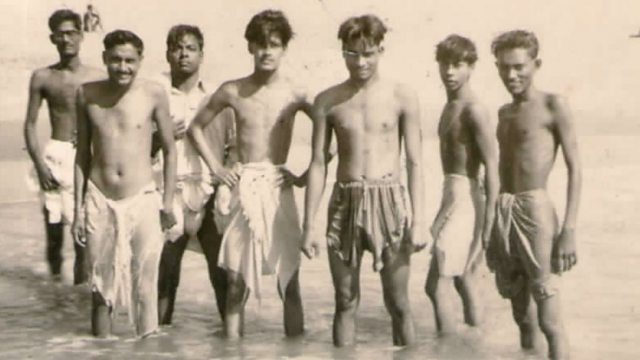
Samir Roy Choudhury (left) and Malay Roy Choudhury
|
via Facebook
In October 1962, young poet Malay Roy Choudhury boarded the
newly launched Janata Express at Patna. The train would stop in Delhi
before it reached Calcutta – a rather tedious journey that would go on
for over two days. Malay hoped Calcutta would be pleasant this time of
the year. His elder brother, Samir, had written to him just before he
had left for Calcutta.
You’ll reach just in time to
see the city being decorated for Durga Puja. Ma arrives in the most
beautiful colours and people make the most creative podiums for her to
be worshipped in. The kash phool would have spread its abundance. You’ll
find them everywhere if you care to look, spread out sleepily in the
emptiness outside the city. The sound of dhak will be everywhere and if
you’re lucky, you’ll find some of the dhakis at the Howrah station when
you arrive.
Malay
wondered if Calcutta had changed Samir. Patna was dry and without a
trace of chill. The narrow seats and the stale air that greeted him in
the third-class compartment were terrifying. He was carrying two small
bags, his underwear peeking out of one, some papers and a few packets of
crisps from the other. It was still early evening, with reluctant
bogies standing around idly, basking in a gentle sun. It was Malay’s
first trip to Calcutta after the establishment of the Hungry Generation.
Before the year would end, Malay would meet American poet Allen Ginsberg in Calcutta.
It
was February 1961 when Ginsberg landed in Bombay (now Mumbai). The Cold
War was still on, a nuclear face-off had just been averted in Cuba and
Delhi was at loggerheads with Peking – a border dispute had pushed the
two countries to the brink of war. And just like everywhere else, poets,
writers and thinkers in India were had been affected too. Ginsberg
visited many places in the country, including Benaras (now Varanasi),
Patna, the Himalayan foothills and Calcutta (now Kolkata). During his
trip, he spent most of his time mingling with like-minded poets,
musicians and artists, and even wrote about them in great detail in
Indian Journals. In Calcutta, between keeping company with Ashok Fakir
in “Ganja Park” – an area near the main road stretching from Chowringhee
to Rashbehari Avenue – and hallucinating at Kali’s feet while lying in
her temples, Ginsberg would walk around the city or watch bodies being
burned in the ghats. To the ever-sceptical Bengali, he might have
seemed like another disillusioned westerner doing the rounds of holy
Indian cities, in search of drugs, sex and a vague notion of exotic
spirituality. But Ginsberg was all that and more. As it turned out, not
many Indians at that time were aware of Ginsberg’s reputation or the
influence he wielded back home.
Ginsberg, of course, had read Howl,
his legendary poem, at Six Gallery in San Francisco by then, and had
begun shaping the American approach and reaction to poetry. What effect
his presence would have on the poets in Calcutta, or they on him, time
would tell vividly. But for now, he was one of them – a poet and a
wanderer, who carried with him a turbulent and disturbed past, with the
belief that here, of all places, he would be accepted no matter how
dirty or disillusioned he was.
The
train now moved slowly, egged on as if by a reluctant inertia. Malay
remembered what Samir had written to him from Calcutta while he was in
Patna.
He had been angry with their father for sending him away
to Calcutta after school. The Roy Choudhurys had decided to shift from
Imlitala, a neighbourhood in Patna, which their father considered
exerted a bad influence on the boys. Pretty early on in life, the place
had exposed them to free sex, toddy, ganja, and much more. Their father
had built a new house in Dariapur and the family had shifted there.
Subsequently, when Samir was sent to Calcutta, it was a double blow for
him and one that didn’t go down very well. Calcutta was a place he knew
almost nothing about. His instructions to Malay had been clear – he was
going to live vicariously through his brother in Patna. On certain days,
Samir would almost be pleading with Malay in his letters.
Dear Malay, Near
the charali next to our house is a woman who sells bidis for two annas.
Buy a packet from her, hide it in your trunk and bring it for me when
you’re in Calcutta. Remember, nobody should know about this. Dada
And another about a month later read:
Dear Malay, Apparently,
there are many things to do here, but I don’t know where to start. I
have made a few friends; we meet at the Coffee House regularly. Deepak
[Majumdar], Ananda [Bagchi] and Sunil [Ganguly] are close to me.
Sometimes we discuss kobita [poetry], at other times, it is the state of
affairs. Everyone is angry here; there are strange people I meet on the
road. They are not like the poor of Imlitala; they have a lost look
about them. They don’t look or feel poor when you talk to them – all you
can understand is death on the inside. I think they have lost a dream.
It makes me feel horrible; I miss the easy poverty of Imlitala...You
must go to Bade Miyan’s paan shop at the end of our lane and tell him
about the paan that I used to have, he will know. You could have one
yourself, but I fear it might not be good for you. You must bring one
for me though. It will cost you one anna. Dada
Malay could not understand from Samir’s letters whether he was happy in Calcutta or not.
But
he sensed some anger. He seemed like a revolutionary without an
understanding of what his revolt was about. Malay wished Samir knew how
much he wanted to see Calcutta – the city he had spoken so much about in
his letters. He greatly desired to visit the city where poetry was read
aloud on the streets; where a Shankha Ghosh, even at the height of his
literary career, could be approached by college students; where Shakti
Chatterjee would recite poetry on the stairs of the Coffee House.
Samir’s shift to Calcutta indirectly helped Malay in many ways.
Advertisement
It
was Ashadh of 1952 when Malay next received a letter from Samir. It had
been raining for two days and the blue inland envelope got a bit wet as
Malay fetched it from the letterbox. Unlike his previous letters, Samir
sounded excited in this one – it was the first time he had forgotten to
mention Imlitala.
Dear Malay, Last
evening, Sunil, Shakti and Deepak came home. My room is small, and the
bed has too many books on it for me to move them. We sat on the terrace
adjoining my chilekotha [an attic-like room]. While it didn’t matter to
either Sunil or Deepak, I was glad I had the small mat Ma had insisted I
bring from Patna. Tha’mma doesn’t stir out of her room after dusk, so
it was OK for Sunil to bring his smoke. Thanks to the gondhoraj lebu
plant that is full of flowers and small bulbs of lemons, the smell of
smoke was confined to the terrace. We talked for a long time;
thankfully, none of them were in a hurry. Tha’mma might ask a lot of
questions tomorrow though. Sunil is full of ideas; he says he wants to
start a magazine. He is still not sure how to go about it though, but he
says he is bored of reading the same kind of writing. I told him what
you and I have talked about so many times. He seemed a bit surprised at
first, and then asked me about you. Deepak was quiet all evening, but he
sang a song later. Kaka came up to meet us. Later, he and Deepak talked
about Hindi film heroines. Their discussion made Shakti and me laugh a
lot. There was not much to eat, but Sunil had bought some pakoras on the
way; we ate them and, later, licked the plate clean. Sunil went through
my books and wanted the Swinburne collection. I can give it to him only
later, which is what I told him. I hope he didn’t take offence though. More later, Dada
Maitreyee Bhattacharjee Chowdhury
Many
of the new writers were Samir’s classmates in City College. There were
other established ones, who frequented the Coffee House, whom Samir had
befriended and would discuss literature with.
Shakti and Sunil
came up quite often; they were close friends, who had been to his family
home in Uttorpara a few times. Sunil was a prolific and acclaimed
novelist, but poetry was his first love. In fact, Samir, who’d
recognised his talent early on, went on to fund and publish Sunil’s
first book of poems, Eka Ebong Koyekjon. Samir would
have intense discussions with Deepak, Sunil and Shakti on many an
evening on the kind of literature they had all grown up with and began
to believe in. Subsequently, he got deeply involved with Sunil in
establishing Krittibash – a journal that launched many a Bengali poet that time. Deepak, Ananda and Shakti were also compatriots in this venture. Krittibash
found “its voice’” in 1953. Samir always kept his brother in the loop
about everything, and Malay would occasionally receive large paper
packets containing literary periodicals and books of poetry. Now
as the train moved towards Calcutta, Malay felt as if his life was
coming full circle. It had been a strange decision to visit the city at a
time when post-Partition vomit and excreta was splattered on Calcutta
streets. Marked by communal violence, anger and unemployment, the
streets smelled of hunger and disillusionment. Riots were still going
on. The wound of a land divided lingered, refugees from East Pakistan
(now Bangladesh) continued to arrive in droves. And since they did not
know where to go, they occupied the pavements, laced the streets with
their questions, frustrations and a deep need to be recognised as more
than an inconvenient presence on tree-lined avenues.
Advertisement
The
feeling of being uprooted was everywhere. Political leaders decided
that the second phase of the five-year planning needed to see the growth
of heavy industries. The land required for such industries necessitated
the evacuation of farmers. Devoid of their ancestral land and in the
absence of a proper rehabilitation plan, those evicted wandered
aimlessly around the cities—refugees by another name. Calcutta had
assumed different dimensions in Malay’s mind. The smell of the Hooghly
wafted across Victoria Memorial and settled like an unwanted cow on its
lawns. Unsung symphonies spilled out of St Paul’s Cathedral on lonely
nights; white gulls swooped in on grey afternoons and looked startling
against the backdrop of the rain-swept edifice. In a few years,
Naxalbari would become a reality, but not yet. Like an infant Kali with
bohemian fantasies, Calcutta and its literature sprouted a new tongue –
that of the Hungry Generation. Malay, like Samir and many others, found
himself at the helm of this madness, and poetry seemed to lick his body
and soul in strange colours. As a reassurance of such a huge leap of
faith, Shakti had written to Samir:
Bondhu Samir, We
had begun by speaking of an undying love for literature, when we
suddenly found ourselves in a dream. A dream that is bigger than us, and
one that will exist in its capacity of right and wrong and beyond that
of our small worlds. Bhalobasha juriye Shakti
Excerpted with permission from The Hungryalists: The Poets Who Sparked A Revolution, Maitreyee Bhattacharjee Chowdhury, Penguin Books.
There
is a certain kind of magnetic attraction that literary figures of the
past hold over young struggling writers of today. We often look to their
work, their lives and lifestyles for inspiration, adopting their
methods and styles into our own experimentations with finding our own
writer’s voice. We look to the past movements and revolutions that have
created the literary landscape of today. Nothing seems to pull a writer
in more than the Beat generation in 1950’s America. Young, scruffy
anti-establishment writers living life on their own terms and rejecting
dominant societal rules has a kind of attraction that makes you
fantasize about travelling across cities with Jack Kerouac and Allen
Ginsberg, with the sun shining on your face – there’s definitely someone
playing the harmonica – living the ideal hippie writer’s life you’ve
imagined through romanticised notion of the Beats. But once you
wake up to the reality of adulthood and working, these images slowly
start to change. Depending on the kind of writer you want to be you
still strive to change the world with your words, create worlds of
wonder, magic and whimsy, or even trigger entire revolutions. While we
may all not end up being these ideal selves we’re created in our minds,
there was a literary movement in India itself, our own Beat generation,
in a way, that changed the way Bengali literature was received, read and
written in the 1960’s.
The Hungryalist Movement was founded by what is referred to as the Hungryalist quartet by Dr Uttam Das in his dissertation ‘Hungry Shruti and Shastravirodhi Andolan’
– Malay Roychoudhury and his elder brother Samir Roychoudhury, Shakti
Chattopadhyay and Debi Roy, alias of Haradhon Dhara. These mavericks of
the avant-garde shook an unsuspecting Calcutta’s (as it was named at the
time) literary and cultural world and became a real force to reckon
with. Members grew in number as more and more poets and writers came
into the folds of this new generation of writers, resulting in one of
the most historically and culturally significant trials of the Indian
literary world. The
Hungryalist movement picked its name from Geoffrey Chaucer’s phrase
“the sowre hungry tyme”. “When a civilisation falls, people tend to eat
every thing that comes their way,” said Malay Roychoudhury in an interview with Nayanima Basu. “Today when I look at West Bengal, the Hungryalist premonition appears prophetic.”
The
1960s was host to a generation of disaffected youth in post-partition
Bengal. They voiced their anger and sense of displacement by creating
literature that challenged the pre-existing colonial perspectives and
traditional readings of Bangla writings to make reader’s question how
Indian literature is perceived and received. As Prof. S Mudgal explains,
“The central theme of the movement was Oswald Spengler’s idea of
History, that an ailing culture feeds on cultural elements brought from
outside. These writers felt that Bengali culture had reached its zenith
and was now living on alien food.”
The Hungry generation was more
than just a group of angry young men. At the time, Bengali literature
was, for lack of a better word, limited and inaccessible for most
people. The Hungryalists wanted more – they wanted a new language, a new
literary space that was open, accessible and representative of all
Bengalis, not just limited to an elite few. “Their entire position was
extremely iconoclastic. To break whatever was held sacrosanct till then,
including the way n which they wrote poetry and the way in which they
lived their lives,” said
Ipshita Chanda, professor of Comparative Literature at Jadavpur
University, to the BBC. Their frustration was shared with not just other
poets, she explains, but with an entire generation of over-educated
people who felt they had no future. The Hungryalist quartet grew
in number and was soon joined over the years with writings by renowned
Bengali voices such as Subimal Basak, Sunil Gangopadhyay, Saileswar
Ghose, Basudeb Dasgupta, Tridib Mitra, Subhas Ghose, Falguni Ray and
Arunesh Ghose, to name a few. These were young writers who came from
humble backgrounds and meagre means, and the political and social
climate of the time only made their voices louder.
This
was a difficult time in the region’s history. Thousands were displaced
and forced to migrate following partition, with no money and no place to
go – no place they belonged to. There was rampant poverty, food
shortages and homelessness, but this immediate reality would never find
its way into the writings and literature of the time – into the living
rooms of the elite who lived sheltered lives in the comfort of their
homes. The Hungryalists were very aware of this reality, and carried
these people’s stories, their histories through words into the limelight
in their pamphlets/bulletins. The movement broke all conventions
of writing – they were different in form, in content and rhythm from the
traditional, ‘elitist’ works that dominated the literary sphere. These
used language that was polite, cultured and ‘civilised’ and the
Hungryalist’s disruption came into this space with a sense of pure
anarchy. While they viewed Tagore’s language as ‘vegetarian’, their’s
focused on being streetwise and colloquial, for the people, raw and
relatable – the “language of life” that was viewed by the rest as vulgar
and obscene.
As Malay Roychoudhury explained,
they identified themselves as a part of the post-colonial period that
disconnected itself from colonial canons. They published their work
through single-sheet pamphlets that they would then distribute in coffee
houses, colleges, and offices. While their anti-establishment antics
may have carved for them a special place in the heart of Allen Ginsberg,
who the Roychoudhurys met during his trip to India
in the 60s, it definitely wasn’t for everyone, especially dominant
Bengali society. Criticising society meant a harsh critique of politics
and those in power. As Nayanima Basu writes,
“The administration’s ire towards the Hungryalists reached its peak
when the poets started a campaign to personally deliver paper masks of
jokers, monsters, gods, cartoon characters and animals to Bengali
politicians, bureaucrats, newspaper editors and other powerful people.
The slogan was, ‘Please remove your mask’.”
Arrest
warrants for eleven of the movement’s poets were issued, and Malay
Roychoudhury, viewed as the face and leader of this bunch of
troublemakers, was arrested on September 2, 1964. His poem‘Prachanda Boidyutik Chhutar’ (translated as ‘Stark Electric Jesus’)
didn’t sit well with the good Bengali people of civilised society, and
he was charged with conspiracy against the state and literary obscenity.
The trial went on for 35 months, he explains,
during which he spent a month in jail. While many of the Hungry poets
slowly began to break away from the movement during this time – many
lost their jobs, faced regular police raids and some ventured into
different fields altogether – Malay Roychoudhury received tremendous
support from other friends and family, even from writers and poets
abroad who read of the news in a Time magazine editorial, such as Octavio Paz, Ernesto Cardenal, and Allen Ginsberg, who even wrote a letter in his support.
The
charges were subsequently dropped by the High Court of Calcutta, but in
the mean time the Hungry generation seemed to have dwindled to a
handful of people. “Some of them carried the news to Europe and I
started getting translated for the little magazines there,” said
Malay Roychoudhury. “My poems were read at New York’s St Mark’s Church
to raise funds to help me. It would have been impossible to fight the
case up to the High Court without this help. I was poor, all my friends
who were part of the movement deserted me, I lost my job with the
Reserve Bank of India during the case, my grandmother died hearing the
news of my imprisonment, and thus, I stopped writing.” But the spirit of
the movement still lives on in the hearts and works of the
Roychoudhurys and many other writers of the time, even if they separated
themselves from the group.
The Hungryalists left an indelible
impact on not just Bengali literature, but that of India. The Hungry
generation are remembered as literary heroes, however romanticised our
notions may be. These were writers that were hungry for a new voice and
found themselves in a storm of politics and bold, brave words that stood
as a declaration for a change, one that they themselves put into
motion.
Read Nayanima Basu’s interview with Malay Roychoudhury here and listen to BBC’s podcast about the Hungry Generation here.
There
is a certain kind of magnetic attraction that literary figures of the
past hold over young struggling writers of today. We often look to their
work, their lives and lifestyles for inspiration, adopting their
methods and styles into our own experimentations with finding our own
writer’s voice. We look to the past movements and revolutions that have
created the literary landscape of today. Nothing seems to pull a writer
in more than the Beat generation in 1950’s America. Young, scruffy
anti-establishment writers living life on their own terms and rejecting
dominant societal rules has a kind of attraction that makes you
fantasize about travelling across cities with Jack Kerouac and Allen
Ginsberg, with the sun shining on your face – there’s definitely someone
playing the harmonica – living the ideal hippie writer’s life you’ve
imagined through romanticised notion of the Beats.
But once you
wake up to the reality of adulthood and working, these images slowly
start to change. Depending on the kind of writer you want to be you
still strive to change the world with your words, create worlds of
wonder, magic and whimsy, or even trigger entire revolutions. While we
may all not end up being these ideal selves we’re created in our minds,
there was a literary movement in India itself, our own Beat generation,
in a way, that changed the way Bengali literature was received, read and
written in the 1960’s.
The Hungryalist Movement was founded by what is referred to as the Hungryalist quartet by Dr Uttam Das in his dissertation ‘Hungry Shruti and Shastravirodhi Andolan’
– Malay Roychoudhury and his elder brother Samir Roychoudhury, Shakti
Chattopadhyay and Debi Roy, alias of Haradhon Dhara. These mavericks of
the avant-garde shook an unsuspecting Calcutta’s (as it was named at the
time) literary and cultural world and became a real force to reckon
with. Members grew in number as more and more poets and writers came
into the folds of this new generation of writers, resulting in one of
the most historically and culturally significant trials of the Indian
literary world.
Candle light photo of Malay Roychoudhury by Subimal Basak
The
Hungryalist movement picked its name from Geoffrey Chaucer’s phrase
“the sowre hungry tyme”. “When a civilisation falls, people tend to eat
every thing that comes their way,” said Malay Roychoudhury in an interview with Nayanima Basu. “Today when I look at West Bengal, the Hungryalist premonition appears prophetic.”
The
1960s was host to a generation of disaffected youth in post-partition
Bengal. They voiced their anger and sense of displacement by creating
literature that challenged the pre-existing colonial perspectives and
traditional readings of Bangla writings to make reader’s question how
Indian literature is perceived and received. As Prof. S Mudgal explains,
“The central theme of the movement was Oswald Spengler’s idea of
History, that an ailing culture feeds on cultural elements brought from
outside. These writers felt that Bengali culture had reached its zenith
and was now living on alien food.”
The Hungry generation was more
than just a group of angry young men. At the time, Bengali literature
was, for lack of a better word, limited and inaccessible for most
people. The Hungryalists wanted more – they wanted a new language, a new
literary space that was open, accessible and representative of all
Bengalis, not just limited to an elite few. “Their entire position was
extremely iconoclastic. To break whatever was held sacrosanct till then,
including the way n which they wrote poetry and the way in which they
lived their lives,” said
Ipshita Chanda, professor of Comparative Literature at Jadavpur
University, to the BBC. Their frustration was shared with not just other
poets, she explains, but with an entire generation of over-educated
people who felt they had no future.
The Hungryalist quartet grew
in number and was soon joined over the years with writings by renowned
Bengali voices such as Subimal Basak, Sunil Gangopadhyay, Saileswar
Ghose, Basudeb Dasgupta, Tridib Mitra, Subhas Ghose, Falguni Ray and
Arunesh Ghose, to name a few. These were young writers who came from
humble backgrounds and meagre means, and the political and social
climate of the time only made their voices louder.
Source: Hungryalist Photos
This
was a difficult time in the region’s history. Thousands were displaced
and forced to migrate following partition, with no money and no place to
go – no place they belonged to. There was rampant poverty, food
shortages and homelessness, but this immediate reality would never find
its way into the writings and literature of the time – into the living
rooms of the elite who lived sheltered lives in the comfort of their
homes. The Hungryalists were very aware of this reality, and carried
these people’s stories, their histories through words into the limelight
in their pamphlets/bulletins.
The movement broke all conventions
of writing – they were different in form, in content and rhythm from the
traditional, ‘elitist’ works that dominated the literary sphere. These
used language that was polite, cultured and ‘civilised’ and the
Hungryalist’s disruption came into this space with a sense of pure
anarchy. While they viewed Tagore’s language as ‘vegetarian’, their’s
focused on being streetwise and colloquial, for the people, raw and
relatable – the “language of life” that was viewed by the rest as vulgar
and obscene.
As Malay Roychoudhury explained,
they identified themselves as a part of the post-colonial period that
disconnected itself from colonial canons. They published their work
through single-sheet pamphlets that they would then distribute in coffee
houses, colleges, and offices. While their anti-establishment antics
may have carved for them a special place in the heart of Allen Ginsberg,
who the Roychoudhurys met during his trip to India
in the 60s, it definitely wasn’t for everyone, especially dominant
Bengali society. Criticising society meant a harsh critique of politics
and those in power. As Nayanima Basu writes,
“The administration’s ire towards the Hungryalists reached its peak
when the poets started a campaign to personally deliver paper masks of
jokers, monsters, gods, cartoon characters and animals to Bengali
politicians, bureaucrats, newspaper editors and other powerful people.
The slogan was, ‘Please remove your mask’.”
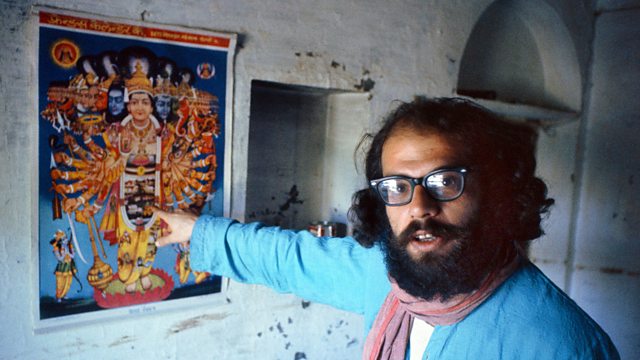
Source: Hungryalist Photos
Arrest
warrants for eleven of the movement’s poets were issued, and Malay
Roychoudhury, viewed as the face and leader of this bunch of
troublemakers, was arrested on September 2, 1964. His poem‘Prachanda Boidyutik Chhutar’ (translated as ‘Stark Electric Jesus’)
didn’t sit well with the good Bengali people of civilised society, and
he was charged with conspiracy against the state and literary obscenity.
The trial went on for 35 months, he explains,
during which he spent a month in jail. While many of the Hungry poets
slowly began to break away from the movement during this time – many
lost their jobs, faced regular police raids and some ventured into
different fields altogether – Malay Roychoudhury received tremendous
support from other friends and family, even from writers and poets
abroad who read of the news in a Time magazine editorial, such as Octavio Paz, Ernesto Cardenal, and Allen Ginsberg, who even wrote a letter in his support.
The
charges were subsequently dropped by the High Court of Calcutta, but in
the mean time the Hungry generation seemed to have dwindled to a
handful of people. “Some of them carried the news to Europe and I
started getting translated for the little magazines there,” said
Malay Roychoudhury. “My poems were read at New York’s St Mark’s Church
to raise funds to help me. It would have been impossible to fight the
case up to the High Court without this help. I was poor, all my friends
who were part of the movement deserted me, I lost my job with the
Reserve Bank of India during the case, my grandmother died hearing the
news of my imprisonment, and thus, I stopped writing.” But the spirit of
the movement still lives on in the hearts and works of the
Roychoudhurys and many other writers of the time, even if they separated
themselves from the group.
The Hungryalists left an indelible
impact on not just Bengali literature, but that of India. The Hungry
generation are remembered as literary heroes, however romanticised our
notions may be. These were writers that were hungry for a new voice and
found themselves in a storm of politics and bold, brave words that stood
as a declaration for a change, one that they themselves put into
motion.
Read Nayanima Basu’s interview with Malay Roychoudhury and listen to BBC’s podcast about the Hungry Generation
Space is being occupied. What does that space stand for? What does
its occupation convey? There are questions being asked about how
non-violence can sustain such protest when it is sought to be quashed
even in America. Can people from disparate cities with different needs
find a common ground besides the one they sit in?
Robert J. Shapiro, former U.S. Under-Secretary of Commerce for
Economic Affairs, wrote: “For the United States it means a middle-class
warfare. When middle-class Americans turn to Washington, they see the
resounding success of the government’s efforts to stabilise the
financial markets – where the top 1% derive most of their wealth. The
rich are back to becoming even richer. That’s the way America has
operated for at least the last generation. What grates on middle-class
Americans this time is that they’ve been getting poorer. And Washington
has done little to stabilise the market from which they derive most of
their wealth, which is housing.”
Would the middle-class be enthusiastic about the homeless? Can such
protests be equalisers? Shapiro demystifies the American fairytale when
he says, “There is little controversy among economists that the fabled
US ‘land of opportunity’ has become one of the world’s most unequal
societies. Using the standard measure (the ‘Gini Coefficient’), America
now ranks 93rd in the world in terms of economic equality. That puts us
behind places such as Iran, Russia and China.”
Thomas Friedman, after attending a literary festival in India,
concluded: “What has brought millions of Indians into the streets to
support the India Against Corruption movement and what seems to have
triggered not only the Occupy Wall Street movement but also initiatives
like Americanselect.org — a centrist group planning to use the Internet
to nominate an independent presidential candidate — is a sense that both
countries have democratically elected governments that are so beholden
to special interests that they can no longer deliver reform. Therefore,
they both need shock therapy from outside.”
The comparison does not quite work. India, the upstart Big Brother,
is trying to clean up the system. It appears to be more organised. But
when dissent is systematised it is in danger of a limited transition.
Or, rather, a transmigration of sole interests. The “outside” is rarely
the philosophical outsider anymore. It might be noted that recently
when the Mumbai stock exchange at Dalal Street attempted to mimic OWS,
it fizzled out within hours. As for shock therapy, was that not the
‘change’ mantra? Does change alter fossilised political dynamics?
* * *
“Sir, yesterday sunrise. He was lynched by a mob.” The poet would not
sit in a colour-coordinated rally, or fast, or give a call to fill up
the prisons. He would not get a stamp of approval from the big powers.
He was not a neo-Gandhi, yet they called him a violent Gandhian.
Remonstration then was not prefixed with words like “peaceful”. They
did not give interviews to news channels or have the support of
industrialists. They would spit out with disgust at the very thought.
Real expectoration. As the world witnesses India playing to the gallery
to fight corruption and prop up the ‘humble’ hero Anna Hazare, I think
about the time when dissent was not pretence. Honest protest fuels
creativity; it does not live off sound bytes. The current people’s
movement is creatively hollow, inspired to protect money garbed as hope.
“I think man has harmed society by first theorising and then putting
it to practice. Take the Dandi March, theorise it and start marching
again. Everybody knows it is a farce. Culture cannot be theorised; it
has to evolve.” These are words from 20 years ago. I was in a
middle-class home in Mumbai’s suburbs to meet the pivot of the Hungryalist Movement, Malay Roy Chowdhury, the man who wrote lines that belched out rancid breath from genuinely hungry stomachs.
There was no dichotomy as the smell and sounds of cooking oil
spluttering reached us in the modest living room – a sofa, chair, dining
table. Was there a dining table? This man did not do the forests of the
tribals, wrote no tomes, no sedititious words as precious as Swarovski
lisped through elocution English. He did not smile benignly as meetings
were disrupted by rightwing groups that throw pamphlets in the air like
tinsel on Christmas tree Christs. There was no rightwing enemy then.
Just as there was no rubbing of shoulders with the powerful. Everything
was the Other.
He could have become a Naxalite and packed bombs with a dynamite
cause. He could have packaged himself as an idealist with a full head
and sore feet and pole-vaulted his way into the land of the
never-say-die dead. He didn’t. He continued to write verse about blood,
gore, the nether regions, the lesser regions. But he also worked in a
bank. And he was not hungry anymore, even though his past was tied up
with the entrails of impotent anger. A past whose hypodermic needle was
rusting, but was a reminder of those high, high days, the withdrawal
symptoms, the cold turkey.
Around the time when the 50s were being buried, and Allan Ginsberg
was shedding his clothes to become a benchmark of sorts, a group of
young men in Kolkata (Calcutta then) who wrote poetry in Bengali and
rubbed their hands in the mud, formed the Hungryalist Movement. It
shocked the lyrically-sanctioned lethargy. The Hungries were about a
counter-gluttony culture, but the name had a deeper meaning meshing
Chaucer’s “the sower hungry times” from the Canterbury Tales and
Spengler’s theory that every culture is a wheel that goes up on its own
but on its way down degenerates and starts eating up other cultures. “1
saw this as the hungry element. A realism based on hunger for a culture,
by a culture,” said Malay.
Hungryalist poetry was considered hysterical, but then it was
striving for complete freedom even from the technicalities of poetry. So
it was that he wrote, “I’ll kick all Arts in the back and go away.” It
wasn’t vacuous bravado. The group got involved in what appeared as
bizarre activities. They wanted to do away with politesse; the fart and
barf were publicly emanated. Even Time magazine in its issue of November
20, 1964, could not help commenting, “To let loose a creative furore
the Hungries last summer sent every leading Calcutta citizen — from
police commissioner to wealthy spinsters — engraved, four-letter worded
invitations for a topless bathing suit contest.” It might seem that the
motive was to strip hypocrisy. Malay, however, recalls it differently.
“None of us thought of protesting, of trying to improve society, but our
writings were like that We got branded as anti-establishment and that
was the first good thing that happened to Bengali poetry!”
But not too good for him. The whole lot of them were arrested for
conspiracy against the state, against society, for corrupting minors,
and Malay had a special charge against him — for obscenity. While the
others were released, some of them even testified against him. He had to
wait for the High Court to acquit him. It could cause a flutter in the
household of anyone. Malay, then single, went through the ache of
watching his father stand by him helplessly as the police broke open his
mother’s steel trunk. His parents had never been to school. “All of us
in the Hungry Movement were first-generation literates, from the lower
income group.” Discovery of culture came by eating what others spread
before him. Hereditary link went back to a grandfather who painted kings
and queens.
That other grandfather of every Bengali did not influence him at all.
“You cannot think of us in terms of Tagore because he was a
billionaire… Our ethos and empathies were completely different not only
from Tagore but from the later poets. When we came, we brought things
from ourselves. which were different from both Bengali culture and
western culture. So we were not immediately acceptable.” For all its
rawness, the poetry bled purposefully: “Spread out your matrix. Give me
peace.”
Was it fear of the self more than a fight that they knew would never
be finished? “Today the images and words are violent, reflecting the
situation, things which are not acceptable to human decency. But, yes,
there was a tendency at that time to please the reader. But when we
started we began questioning ourselves: why should we please the reader,
why not shock him? He’ll remember you.”
The authorities then could also have seen a devious purpose —
political uprising — in all that the Hungries wrote. A literary critic
had said of Malay that even his love poems were political.
“Everything
in life can be interpreted in every way. See. You may not be a believer
in god, but your sense of fear, your longing for something could be
interpreted as a belief. Some critics are more inclined to interpret
things for political purposes. Anyway, nobody does anything
internationally apolitical.” Yet, he did not call himself political,
living in the “cloaked melon” of an ideology. “We were cultural
outsiders. We brought to Calcutta certain things that we got from
outside.”
The Hungryalist Movement was not to set up something on the fringes.
but to fight for a place within the culture that was nibbling away at
anything that met its gaze. Therefore, the sidetracking was not exactly
palatable. He was not invited to official functions. “I missed out on a
large audience. After I was convicted all my friends left me. It became
very difficult to get my poems printed and I also gave up writing.
Meanwhile, I did not think of literature at all and kept busy playing
with my children.” The revolution had come full circle. The man who used
to roam the interiors of the country, staying with farmers and sleeping
on the hard floor when “living was more important than poetry”, found
it increasingly difficult to do so. He realised that he had to guzzle
bottled fizz because drinking tap water gave him an upset stomach.
It was the candour of someone who had experienced “Million glasspanes
are breaking in my cortex”. What changed? Ennui? Apprehension? “The
establishment made me like that – now I feel I am a confused man.” It
was a confusion generated by what was between the lines, “The third
person influencing you without allowing you to think. It is impossible
to decide after a point what should he done within the structure
itself.”
Did the comfort of a suburban home and time spent with family bring a
sense of peace or was there regret? “A lot of my friends became
Naxalites but I did not join them because that sort of revolution was
not acceptable to me. As for the establishment, it is also part of
culture and its degeneration.” In the process of growing are painful
moments when you have to shed a few things, disown others. Do you
swallow the venom? Was Hungryalism still relevant to him? “I know I have
changed, my poems have changed. Now it will be a fraud to call myself a
revolutionary.”
There are people walking down the streets, sitting around campfires.
People remember the flaky words of quivering voices, immortalised by
cocooned dissent. Malay did not take that road and preferred to ask in a
poem, “Shall I put on the shirt? Gulp few morsels? Slip off through the
terrace?”
Rebellion is a robot now as the system and the counter-system peek
into dark crannies and pull out those who can be taken in. Malay’s words
seem apt, “The metropolis burn/ A naked priest elopes with Shiva’s
phallus.”
Take your pick. Today’s mutiny will not leave you empty-handed.
Farzana Versey is a Mumbai-based writer. She can be reached athe
http://www.farzana-versey.blogspot.com/
In the early 1960s, Kolkata was in the grip of major food shortages, an
insecure and incompetent government and disillusionment amongst the
young intelligentsia with the post-colonial political establishment. It
gave rise to the so-called 'Hungry Generation' , a band of irreverent and articulate angry young
men (and woman) who cocked a snook at the establishment. Alan Ginsberg (1926 - 1997) was an active supporter.
The Hungry Generation (Bengali: হাংরি
জেনারেশান) was a literary movement in the Bengali language launched by
what is known today as the Hungryalist quartet, i.e. Shakti
Chattopadhyay, Malay Roy Choudhury, Samir Roychoudhury and Debi Roy
(alias Haradhon Dhara), during the 1960s in Kolkata, India. Due to their
involvement in this avant garde cultural movement, the leaders lost
their jobs and were jailed by the incumbent government. They challenged
contemporary ideas about literature and contributed significantly to the
evolution of the language and idiom used by contemporaneous artists to
express their feelings in literature and painting.[1]
The approach of the Hungryalists was to confront and disturb the
prospective readers' preconceived colonial canons. According to Pradip
Choudhuri, a leading philosopher and poet of the generation, whose works
have been extensively translated in French, their counter-discourse was
the first voice of post-colonial freedom of pen and brush. Besides the
famous four mentioned above, Utpal Kumar Basu, Binoy Majumdar, Sandipan
Chattopadhyay, Basudeb Dasgupta, Falguni Roy, Subhash Ghosh, Tridib
Mitra, Alo Mitra, Ramananda Chattopadhyay, Anil Karanjai, Saileswar
Ghosh, Karunanidhan Mukhopadhyay, and Subo Acharya were among the other
leading writers and artists of the movement.
An example, transcribed by me, below.
"So", by Samir Roychoudhury
O Sir, nobody uses the Jadhavpur Subway for a road crossing.
During the night, the aristocrat lunatics sleep there
A passenger queried, "Is the taxi-meter okay?"
I delivered a counter, "Is the country okay?"
The poem that tipped the balance against the movement was "Stark Electric Jesus", by Malay Roychoudhury. The authorities never got the meaning of the words The 'Hungryalists',
(as they termed themselves,) were accused of obscenity and conspiracy
against the state, and many lost their jobs and some were imprisoned for
a while.
The Hungry Generation
Quote:
Allen Ginsberg arrived in early 1960s
Calcutta to discover a collective of angry young poets whose
anti-establishment antics were uncannily reminiscent of his own past.
This is the story of the so-called Hungry Generation.
Fifty years later, we follow in the footsteps of the Beat Generation to
the literary centre of India and go in search of the Hungryalist poets.
Who were they? Where did they fit with a rich Bengali literary tradition
that includes the great Rabindranath Tagore? What eventually led to
their arrests, imprisonment and disbandment?
The Hungry Generation were a special breed - born in the slums, but
highly educated and primed for a revolution in both literature and
society. Through their verse, they broke strict rules of Bengali poetry
as well as social taboos. In their actions they rubbished 'bourgeois'
Bengali polity - consciously acting without manners or etiquette,
burping, farting and using bad language.
They also used clever stunts to attack local officials and politicians,
and held readings in socially unacceptable venues such as brothels,
opium dens and graveyards. Hungryalist poets, such as the Roychoudhary
brothers, and Utpal Kumar Basu, stood for the outsiders of society.
Eventually the authorities had enough. Hungryalists were rounded up and
arrested on charges of obscenity and conspiracy against the state.
Ginsberg attempted to intervene, sending letters of support. US literary
journals carried the story and printed Hungryalist poetry. The movement
floundered.
But despite this, we discover that the Hungryalist anti-establishment
spirit is very much still alive in modern-day Calcutta today.
Produced by Dom Byrne
A Blakeway production for BBC Radio 4.
According to
Malay Roychoudhury, even fellow movement poets, Utpal Kumar Basu,
Saileswar Ghosh, Subhash Ghosh and Shakti Chattopadhyay testified
against him at his trial.
One of the presenters is Utpal Kumar Basu's son, Feroz Basu,
The other presenters are Ipshita Chanda and Deborah Baker, with Samir and Malay Roychoudhury's comments.
Bowering, OC, OBC (born December 1, 1935) is a prolific Canadiannovelist, poet, historian, and biographer. He has served as Canada’s Parliamentary Poet Laureate. He was born in Penticton, British Columbia, and raised in the nearby town of Oliver, where his father was a high-school chemistry teacher. Bowering is author of more than 100 books.
When the Indian Hungryalist, also known as Hungry generation, poet Malay Roy Choudhury, was arrested at Kolkata, India, Bowering brought out a special issue of Imago for helping the Indian poet in his trial.
Rudyard Kipling and Allen Ginsberg, Madhya and Uttar Pradesh, India
While Rudyard trekked around tirelessly for the Civil and Military
Gazette, Allen sought inspiration from the Bengali poets of the
Hungryalist movement and tested the limits of the bohemian lifestyle in
India's holiest city, Varanasi. Voyages Jules Verne's tour covers both –
nights under the stars in the landscape that gave birth to The Jungle
Book and Kim, and time in Varanasi for some Ginsbergian howling.
Dom Moraes. Francis Newton Souza. A painter and a
poet brought together in a cross pollination of occupations, both
linked by lines and names distorted or undistorted as the case may be.
In a sputter of interviews, to begin with, by Dismus Bambai, who, of
course, lives in Mumbai. There is a priest from the school shaking his
head over toilet distortions, in brilliant schoolboy lines, when Francis
Newton, or rather New, expressed himself and signed it X. There is a
jump cut forward to a woman called Miss Henry, who modelled nude and who
seems to have been borrowed from Miss Henrietta, the one Dom Moraes
abandoned on the pretext of buying cigarettes and never saw again. There
is a mad mother who was driven to chase FN around the kitchen table
with a knife because of the nude painting he made of her. The daughter
who talks about life with her father in Delhi during the Emergency when
he painted Indira Gandhi as two eyes in a black dot.
Advertisement opens in new window
Dismas’s world is
more or less straight but stuffed with the odds and ends of Thayil’s own
experience in New York—the immigrant colony and the Indian diaspora in
Jackson Heights.
Skip to the way Dismas got his interview with New, who
is living in New York, accompanied by artist girlfriend Goody
Lol—shades again of another living person, Souza’s artist girlfriend or
muse whose surname was Lal and who was learning to copy his work against
a time when he would no longer be able to paint. The result is a tangle
of canvases, a room called Disorder Central and a panjandrum of
paradoxes, forget the collective noun nonsense, but that is the way
Thayil tinkers with words and sometimes with worlds. Dismas’s world is
more or less straight, but stuffed with the odds and ends of experience
that Thayil gleaned during his stint in New York—the immigrant colony
and the Indian diaspora dotting Jackson aka Jaikisen Heights.
Unsurprisingly, Francis Newton Xavier is elusive and sparing with his
interviews—but he can be summoned in a crisis, like getting someone out
of jail after a heroin bust. Dismas finds out more about the
painter-poet or blocked poet than he wants to during his stint with the
Times of Bharat with Mrs Merchant—by now the reader has got to the point of wondering who everyone is, so hello, she sounds familiar.
In this dark atmospheric text Thayil encapsulates the turbulent chaos
that makes up the artistic world of lines—while emphasising that poetry
is no use unless it picks up a gun. Terrorism and suicide are poetry
and nothing else is. FN’s painting actually loses out to his poetry—that
single book which was printed and a plummy English accent from nowhere.
Interlinked is a Dalit poet called Doss, who steals the term
Hungryalists from the Bengalis or at any rate is credited with inventing
it, since Ginsberg and the Beat poets were well hung. Inevitably,
fornication is part of this poetic verses over the first non-English poet who won the Hawthornden
prize and his unpublished book of chocolate saints, even while the
chocolate saint art exhibition recalls all those saintly art
installations concocted out of unmentionable materials.
At one level, this is Thayil writing about himself, struggling with
poetry and poets and the way people assess them, especially the critics
who are possibly the worst of all. Arun Kolatkar has a cameo confronting
a journo whom he wishes would just leave him alone. Artists prefer
solitude, though once they hit the public eye it becomes a cult kind of
thing—their quirks and their lives attract stalkers and the wrong kind
of fans. Dismus, infected by FN, starts out to write his own book on the
heels of a drug bust that leaves him jobless. The question is, who is
who and what is why? Does Thayil’s story need real lives to fictionalise
or is reality the crutch to fiction—at one level it possibly does. The
poetic underbelly needs actual excess, though we instinctively expect it
after all; all excess is the same violation. Dismus turns against New
when he writes his own book and New, teetotaller, no longer poet, serial
deserter, visiting India for show 66 fades out of the canvas. The
various voices and the back and forth of concept, brush, pencil and love
distorted ends—but not completely without trace, and the end is given
to Goody, the last of the chocolate saints in New’s life, the one who
held out against all odds and mad mother’s voices. In struggle, Thayil
hints, lies hope for the artist, in my end is my beginning.
Malay Roychoudhury (b. 1939 ) is a Bengali poet, best known for launching the Hungryalist movement
in the 1960s. The author of more than seventy books including novels,
poetry collections, drama, short stories, essays, he has also translated
Blake, Ginsberg, Tzara, Cocteau, Cendrars, Lorca, Mayakovsky, Rimbaud,
Rajkamal Chaudhary and many others. He has edited the literary
periodical ZEBRA and co-edited anthologies of Postmodern Bangla Poetry and Postmodern Bangla Short Stories which include writers from both India and Bangladesh. He was prosecuted for his poem Stark Electric Jesus in 1964-66. He has refused to accept a Sahitya Akademi award, which is the Government of India's highest award for literature.
This is a path-breaking literary movement that took form in Kolkata. Hungryalists comprise
of avant-garde writers who have challenged contemporary ideas in
literature and culture, making significant contributions to the
language, since the sixties. Some of the famous poets of this movement
include Binoy Majumdar, Malay Roy Choudhury, Tridib Mitra, and Falguni
Roy. Fiction writers attached to this movement include Basudeb Dasgupta,
Malay Roy Choudhuary, SandipanChattopadhyay and others.
Victoria Memorial: Is poetry regaining relevance? Not
yet, said poet-author Jeet Thayil during a talk on Day 2 of the Tata
Steel Kolkata Literary Meet, co-organised by the Victoria Memorial Hall
in association with The Telegraph, on Tuesday.
Thayil's latest book, The Book of Chocolate Saints, is a novel about poets and he has used some techniques of poetry while writing it.
The world around him may not warm up to poetry yet, but the
poet and novelist in Thayil are never at odds. "You bring the same kind
of tools and obsession to your writing, only the form is different,"
said Thayil, who inaugurated the latest edition of Kalam with a
self-composed verse, along with three other poets.
"Inaugurating a literary meet with poetry can only happen in a city like Calcutta," said the author of These Errors Are Correct, giving the city a thumbs up.
Thayil read out excerpts from his new book to the eager audience before talking to novelist Sandip Roy about its making.
Thayil had hit on the idea of a book while working on a BBC
documentary on the Hungryalist poets of Bengal, especially Malay Roy
Choudhury. "The characters literally jumped out at me," he said.
The Book of Chocolate Saints is about a poet, Newton Francis
Xavier, who is full of gloom and doom. His partner and muse, Goody Lol,
is on the other hand full of hope. "Xavier comes alive with destructive
behaviour, a truth about most people battling an addiction," said
Thayil, who said he presented his protagonist without any filter.
Xavier's character comes alive in the memories of others,
mostly artists and poets of the '70s and '80s in Mumbai. "Xavier is easy
to admire from a distance. But you won't like him till the last part of
the book," Thayil said.
The other inspiration for the book was the first chapter of Thayil's own Narcopolis.
The book about a "cruel, self-destructive" poet who like
Picasso and Ayn Rand elevated his art but led a broken life makes
fiction meet non-fiction. Some real personalities like the author's
father, journalist-writer T.J.S. George, make their way into the plot
that offers readers a taste of dark humour.
"During my journalism days I had covered the murder of a Sikh
American, Balbir Singh Sodhi of Arizona. The research that went behind
my news report now finds a place in my book," Thayil said.
Speaking about the Mumbai poets of the '70s, '80s and '90s,
Thayil said: "These poets were not a generous lot. They never welcomed
women and newcomers. I was not even allowed on the fringes."
The conversation was peppered with personal experiences, some of which have been woven into his current book.
The
Books and web pages we have read so far on Allen Ginsberg, the American
poet of Beat movement, have one thing in common. They do not bother to
examine the impact India had on his inner self and identity, and the influence we Bengali poets, artists and thinkers of the Hungryalist movement had on Ginsberg’s post-India poetry and literary persona. This is despite the fact that Allen Ginsberg’s longest span outside USA was spent in Kolkata and Benaras where the Hungryalists resided during the sixties.
Allen
Ginsberg was the poet, short-story writer and editor Samir
Roychoudhury’s guest for about a week at his Chaibasa hilltop hutment
during Hindu Rathayatra festival in 1962.
In April 1963 Ginsberg visited younger brother of Samir, i.e. Malay Roychoudhury at their Patna
residence..Ginsberg along with Peter Orlovsky resided in the same
locality, i.e. Bangalitola , where Hungryalist painters Anil Karanjai
and Karunanidhan Mukhopadhyay had their studio.
None of the Hungryalists knew about him prior to his arrival in India. We read his poems for the first time in 1963 when Lawrence Ferlinghetti sent us books of Beat poets.The
Hungryalist movement had been launched from Patna in November 1961 by Malay Roychoudhury, Shakti Chattopadhyay, Debi Roy and Samir Roychoudhury.
The word Hungryalism was coined by the Hungryalists from English poet Geofrey Chaucer’s line In the Sowre Hungry Tyme.The Hungryalists felt that the post-colonial dream of a new,ecstatic , resurgent India
had turned sour due to license and permit raj of a corrupt
bureaucracy-politician nexus and the country was hurtling towards a
nightmare after partition of the Bengali time and space.
The
philosophical base of the movement, in keeping with the Chaucerian idea
of Hungry time, was drawn from Oswald Spengler’s sense of history.
Spengler,more or less like Hindus, had seen history not as a linear
progression, but as the flowering of a number of self-contained
cultures, each with a characteristic spiritual tone, or conception of
the space within which they are to act. Spengler had also argued that
cultures go through a self-contained process of growing, going through
their seasons, and perishing. There were no historically intelligible
laws to this process.
The
Hungryalists were impressed with the idea. Spenglerian argument that a
culture is creative during its ascendancy, when it depends upon its own
productive resources. Once the creativity reaches its zenith, the
culture starts waning, and starts feeding on alien resources. As a
result, the culture starts degenerating, and its hunger for outside
supplements becomes insatiable. The Hungryalists felt that there was no
further scope to produce cultural and intellectual giants like Rammohan
Ray, Vidyasagar, Vivekananda and Rabindranath Tagore.
ALLEN ARRIVES IN INDIA
Like all American tourists, including Gary Snyder, Allen Ginsberg and Peter Orlovsky had landed at Bombay
(now Mumbai) port in formal Western attire. They visited North and
North-East Indian tourist spots and hill-stations with their coat,
trousers, tie, shirt, shoes, socks on. Once they arrived at Calcutta
(now Kolkata), their metamorphoses began, They threw away their Western
dress and clothed themselves in home-attire of the Hungryalists of the
time, viz., handloom kurta-pyjama and rubber chappal footwear, with a
cotton sling bag hanging on the shoulder. They allowed their hair and
beard to grow like some of the Hungryalists.
The
reason why Ginsberg was attracted to this Bengali literary movement is
because there had been continuous media coverage of activities of the
writers, poets, and artists preceding his arrival in India.
It is interesting to note that he did not make friends with poets and
artists of Marathi, Hindi, English, Punjabi etc. languages though he
visited those states also. When he arrived in Kolkata the movement had
on its platform such literary names as Sandipan Chattopadhyay, Binoy
Majumdar, Utpalkumar Basu, Basudeb Dasgupta, Pradip Choudhuri, Subimal
Basak, Subo Acharya, Falguni Roy, Saileswar Ghosh, Sambhu Rakshit, Tapan
Das, Ramananda Chattopadhyay, Subhash Ghosh, Satindra Bhoumik,
Arupratan Basu, Haranath Ghose, Bhanu Chattopadhyay, Nihar Guha,
Amritatanay Gupta, Shankar Sen, Ashok Chattopadhyay, Jogesh Panda,
Manohar Das and many others.
Allen
Ginsberg’s logo of three fishes with one common head displayed in all
his post-India publications, albums, cassettes, exhibition cards etc,
which appeared for the first time in his India
journals published by City Lights, was a replica of the engraved
drawing on the stone floor near the entrance to the tomb of Emperor
Jalaluddin Muhammad Akbar. The meaning of this drawing was explained to
Ginsberg by Malay Roychoudhury, when they visited Khudabaksh Library at Patna
where the same drawing was found on the cover of a Persian book, which
was the famous “Deen-E-Ilahi” written by the Emperor, a treatise in
which the Emperor had aspired to combine the tenets of Islam, Buddhism
and Hinduism. Christianity had not entered the kingdom till then.
Ginsberg had come to India for a makeover of the image for which Jack Keruak had warned him of a quick burn- up. He did not go to Nepal like other foreigners who used to halt for a couple of days at Malay’s Patna house. Instead of a makeover, India
gave Ginsberg a genuine new image .Even Peter Orlovsky had a changeover
through his torrid affair with the lady guitarist Manjula Sen. In fact
when Ginsberg departed for the USA, Orlovsky had stayed back in the company of Hungryalist artists of Benaras.
A CHANGED GINSBERG
Allen
Ginsberg was in awe with the depth of tolerance and resiliency of
Indian masses. For the common Indian man, as well as the Hungryalists
who all came from Hindu family, such binary opposites as God and Devil,
and therefore, pure good and pure evil, were non-existent. In the
company of Shakti Chattopadhyay, Asoke Fikir and Karunanidhan
Mukhopadhyay, Ginsberg met many religious persons such as Sri Sitaram Omkardas
Thakur, Swami Sivananda, Meher Baba, Swami Satyananda, Sri Gopinath
Kaviraj, Sri Kalipada Guharai, Sri Bankebihariji, Sri Shambhu Bhartiji
and sundry godmen at the burning ghats. Being born in a Jew family,
absence of the binary opposites was a riddle for him. A professor from Illinois
who visited Ginsberg at his Kolkata hotel, remarked that Ginsberg was
transformed into revolt of the shudras poet;that is exactly what the
Hungryalist poets were called before Ginsberg’s arrival.
Allen
Ginsberg’s “Howl” and “Kaddish” were products of a social consciousness
squeezed out of clash of monotheistic binary opposites. After his life
in India,
and time spent with Hungryalists, he was unable to write poems in the
same vein as that of “Howl” and “Kaddish”. This is evidenced from his
failed attempts that we find on the pages 134, 135, 136, 176, and 177
(City Lights edition) of Indian Journals. His post-Indian poems have
Indian breathing span and Hungryalist rhythm sequences.
Acceptance
of Akbar’s three-bodied fish by Ginsberg as his logo reveals that he
had spiritually disowned monotheistic American inheritance in 1963
itself though he converted to Buddhism in 1972. Malay Roychoudhury has
written in April 2007 issue of “The Storm” that when Ginsberg visited
his Patna
house, he had shown Malay a brick-size stone from an ancient Buddhist
temple on which small Buddhas were carved out. Ginsberg had washed it in
soap water and cleaned the stone with his tooth brush. This real-life
experience was enough to relieve him from his Blakian hallucinations,
and extra-mundane claims of visionary supernatural senses and
impalpability of consciousness. He went back a different man.
CONCEALMENT OF INDIAN INFLUENCE
Allen
Ginsberg did try to conceal, it appears, the Hungryalist literary
inputs and change of spiritual persona by jamming his Indian Journals
with photographs of naked Hindu saints, famishing fakirs, beggars,
lepers and destitutes. Malay Roychoudhury’s photo shop owner father had
rebuked Ginsberg when he found that all the shots of a film contained
such snaps. Ginsberg’s subsequent activities reveal that the
postcolonial Indian social turmoil of the sixties sharpened his post-
McCarthyan American teeth.
Though
TIME magazine in its issue of November 20, 1964 had written that it was
Ginsberg who influenced the Hungryalists, the fact is other way round.
Hungryalists had indelible impact on all dimensions of his identity.
Simply look at him how he was when he came to India,
and how he looked when he went back. One wonders why Ginsberg preserved
manifestoes, bulletins, magazines etc of the Hungryalist movement at Colombia and Stanford University archives, and at the same time kept silent about them in his published journals!
Ginsberg carried a harmonium from Benaras when he returned to USA,
and introduced the custom of extempore poetry composition, and singing,
while playing on the harmonium. When he was in Benaras , Anil Karanjai
and Karunanidhan Mukhopadhyay, the Hungryalist painters, and Hindi poet
Nagarjuna (a Buddhist), had introduced him to this musical instrument,
which is played on by devotees when they sing poems composed by
Tulasidasa, Kabirdasa, Meera Bai, Tukaram, Krittibas, Ramprasad Sen and
other saint poets. Ginsberg had found the same tradition at the
Vaishnava, Shaivaite and Ramakrishna ashrama temples in Mayapur, Nabadwip, Puri, Chaibasa, Patna, Gaya,
and Kolkata. According to Malay Roychoudhury, Ginsberg perfected
playing on the instrument at the residence of Malay’s cousin sister
Savitri Banerjee, where her daughters were playing on the harmonium and
singing compositions of Bengali poets Rabindranath Tagore, Kazi Nazrul
Islam, Atulprasad Sen and Dwijendralal Roy.
The Hungryalist influence in this regard had gone beyond Ginsberg in USA, inasmuch as several young American poets adopted this tradition after importing harmoniums from India. Moreover, during the sixties, translated Hungryalist writings appeared inmagazines of United States, Europe, Australia and the Latin American countries, such as City
Lights Journal, Salted Feathers, El Corno Emplumado, San Francisco
Earthquake, Trace, Burning Water, Inetrgalactica, Imago,
Klactoveedsedsteen, Ramparts, Whe’re, El Rehilite, Guerilla, Panorama,
Kulchur, Trobar ,American Dialogue, Evergreen Review, Folder etc.
THE HUNGRYALIST OUTREACH
It
would also be worthwhile to mention that Lawrence Ferlinghetti, Leroy
Jones (Amiri Baraka), Margaret Randall, Carol Berge, Eric Motram, Howard
McCord, Daisy Aldan, Allan de Loach, Robert Kelly, Dick Bakken, Gordon
Lasslet, Allan Van Newkirk, Carl Weissner, Barney Rosset, George Dowden,
Ida Spaulding, James Laughlin, Lita Hornick, Bonnie Crown, David Antin,
Joel Oppenheimer, Dan Georgakas, Diane Di Prima, Octavio Paz, Ernesto
Cardenal, George Bowering, Paul Blackburn, Allen Hoffman, Clayton
Eshleyman, Carol Rubenstien, Armand, Schwerner, Ted Berrigan, Jerome
Rothenberg, Roberto Juarroz and several other writers, poets, artists
had creative contact with the Hungryalists. Some of them had visited India and participated in Hungryalist happenings. In New York,
poets used to read from Hungryalist writings to raise funds to enable
Hungryalist writers to defend themselves during their 35 month long
tortuous trial at dinghy Bankshal Court. Washington State University had published Malay Roychoudhury’s controversial poem Stark Electric Jesus. Bowling Green University had a writers’ workshop on Hungryalist writings. Illinois University has a Hungryalist archive. Anil Karanjai had a painting exhibition in a gallery at Washington. In India Prof. Swati Banerjee has done her M. Phil.on a comparative study of Hungryalist and Beat Literature.
Ginsberg’s
declaration that “if it isn’t composed on the tongue, it is an essay”,
is an insight he received from the stories of oral poets of 19th
century Kolkata (Bhola Moira, Anthony Firingi, Ram Basu, Jagneshwar
Das,Gonjla Guin, Nityananda Boiragi, Nilmoni Thakur, Nrisingha Rai,
Bhabani Banik, Krishnakanta Chamar, Raghunath Das, Haru Thakur, and many
others, who incidentally were mostly “revolt of the shudras poets”).
Ginsberg came to know about them from Asoke Fakir, whose Champahati
hutment used to be frequented by Hungryalists for substance celebration.
Allen
Ginsberg has described Asoke Fakir as “saffron robed long black hair
Negro” in his Indian Journals. Asoke was rather good looking. Author
Shyamal Gangopadhyay had written a novel based on the colourful life of
Asoke Fakir. The first thing Asoke did to foreign writers was to give
them a shock of their life by taking them to the Nimtalla Ghat, the
Hindu funeral place where dead bodies are regularly burnt on pyre logs.
This was an experience which Allen and Peter had never encountered
before. Thereafter whichever city or pilgrimage centre Ginsberg visited,
he invariably went to the Burning Ghat like a haunted man, even in such
remote tribal places like Chaibasa.
Hindi
poet Nagarjuna had told us that Allen used to spend brooding hours all
alone at the famous Manikarnika Burning ghat almost everyday at Benaras,
and that his tanned skin and long black hair gave him such an Indian
identity that he freely entered all Hindu temples, which are otherwise
barred for non-Hindus. Ginsberg was fascinated with the funeral pyre as
the burning dead body was a constant reminder of inevitable mortality, a
reminder that the living flesh is tender and vulnerable. A grave, on
the other hand, gave a false notion of immortality. We are sure that his
post-India discourse is built on this premise.
The
anti-substance law was enacted in 1980s. Ginsberg was surprised to find
easy availability of ganja or the Indian marijuana, bhang, hashish,
opium. Etc. at or near all Burning Ghats
from government-approved shops. These herbal inebriants have remained
ritualistc inputs for Hindu devotees of certain order, including some of
the Hungryalists who were devotees of any Hindu cult. Obviously, the
Hungryalists did not consider these herbs to be drugs or narcotics.
However, for Allen Ginsberg they were. He felt like defying US law in India.
He found out that for the common Indian man, use of these herbs was
neither unnatural nor immoral. He drew support from this experience and
advocated loosening of legal restrictions on the herbs after he returned
to USA. The Hungryalists were never into chemical substances.
(Tridib
Mitra and his wife Alo Mitra edited two Hungryalist magazines, one in
English named “Waste Paper” and the other in Bengali named Unmarga. They
also edited collections of letters written to Hungryalists: one in
English and another in Bengali. These collections and manifesto,
bulletins etc .are available at the Hungryalist archive of Little
Magazine Library and Research Centre, 18M,Tamer lane, Kolkata 700 009.)